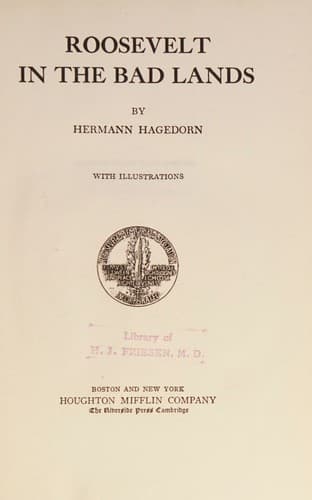
Biography; Frontier and pioneer life -- Dakota Territory; Roosevelt, Theodore, 1858-1919
Poor "Dutch" Van Zander drank up his last remittance. "There," he
cried, "I have blown in a hundred and twenty thousand dollars, but
I've given the boys a whale of a good time!" He gave up drinking
thereafter and went to work for the "Three Seven" outfit as an
ordinary cowhand. He became a good worker, but when the call of gold
in Alaska sounded, he responded and was seen no more in his old
haunts. A few years later he appeared again for a day, saying that he
was on his way to his old home in Holland. A month or two later news
filtered into Medora that the brilliant and most lovable Dutch
patrician's son had been found, dead by his own hand, in a cemetery in
Amsterdam, lying across his mother's grave.
Twice Roosevelt's path crossed Joe Morrill's, and each time there was
conflict. Morrill opened a butcher-shop in a town not far from Medora,
and it devolved on Roosevelt, as chairman of the Stockmen's
Association, to inform him that, unless he changed his manner of
acquiring the beef he sold, he would promptly go to jail. The shifty
swashbuckler closed his shop, and not long after, Roosevelt, who was
at the time serving on the Civil Service Commission in Washington,
heard that Morrill was endeavoring to have himself made marshal of
one of the Northwestern States. The "reference" Roosevelt gave him on
that occasion was effective. Morrill was not appointed; and what
happened to him thereafter is lost to history.
In 1890, Roosevelt was at the ranch at Elkhorn with Mrs. Roosevelt; a
year later he hunted elk with an English friend, R. H. M. Ferguson, at
Two Ocean Pass in the Shoshones, in northwestern Wyoming. That autumn
the Merrifields moved to the Flathead country in northwestern Montana,
and Roosevelt closed the ranch-house. A year later he returned to
Elkhorn for a week's hunting. The wild forces of nature had already
taken possession. The bunch-grass grew tall in the yard and on the
sodded roofs of the stables and sheds; the weather-beaten log walls of
the house itself were one in tint with the trunks of the gnarled
cottonwoods by which it was shaded. "The ranch-house is in good
repair," he wrote to Bill Sewall, "but it is melancholy to see it
deserted."
Early the next spring Roosevelt took Archibald D. Russell, R. H. M.
Ferguson, and his brother-in-law Douglas Robinson into partnership
with him and formed the Elkhorn Stock Company, transferring his equity
in the Elkhorn Ranch to the new corporation.[24]
[Footnote 24: See Appendix for a statement of
Roosevelt's cattle investment.]
It was at the end of a wagon-trip to the Black Hills, which Roosevelt
took with Sylvane and Hell-Roaring Bill Jones in 1893, that Roosevelt
met Seth Bullock.
Public-domain text, read in full here on John Shaqi.
Reviews
Reviews
No reviews yet
Be the first to share your thoughts on this work.
Elsewhere in the archive
Join the Discussion
Join the discussion
Sign in to leave a comment or review.
Sign InorCreate an account