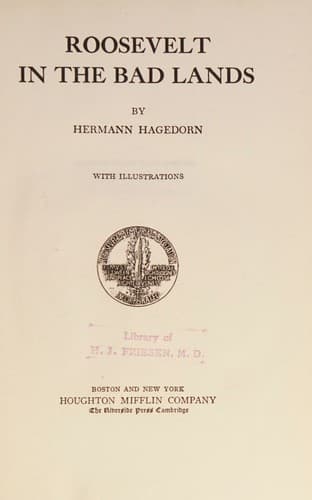
Biography; Frontier and pioneer life -- Dakota Territory; Roosevelt, Theodore, 1858-1919
He returned to France. The French people were in a restless, unhappy
state. More than once, war with Germany seemed imminent. The
Government was shot through with intrigue and corruption. The Marquis,
with all the faults of his temperament, was an idealist, with a noble
vision for his country. He saw that it had fallen into the hands of
base, self-seeking men, and he grasped at every means that presented
itself to overthrow the powers that seemed to him to be corrupting and
enfeebling France. He became an enthusiastic follower of Boulanger;
when Boulanger fell, he became a violent anti-Semite, and shortly
after, a radical Socialist. Meanwhile, he fought one duel after
another, on one occasion killing his man. More than once he came into
conflict with the law, and once was imprisoned for three months,
accused of inciting the populace to violence against the army. There
were rumors of plots with the royalists and plots with the anarchists.
It did not apparently seem of particular importance to the Marquis by
whom the Government was overthrown, so it was overthrown.
His plans did not prosper. Anti-Semitism grew beyond his control. The
Dreyfus affair broke, and set the very foundations of France
quivering. What the Marquis's part in it was, is obscure, but it was
said that he was deeply involved.
His attention was turning in another direction. France and England
were struggling for the possession of Central Africa, and the Marquis
conceived the grandiose dream of uniting all the Mohammedans of the
world against England. He went to Tunis in the spring of 1896,
commissioned, it was said, by the French Government to lead an
expedition into the Soudan to incite the Arabs to resist the English
advance in Africa.
Whether the Marquis actually had the support of the Government is more
than dubious. When he set out on his expedition to the wild tribes of
the Tunisian desert, he set out practically alone. At the last moment,
the Marquis changed his Arab escort for a number of Touaregs, who
offered him their services. They were a wild, untrustworthy race, and
men who knew the country pleaded with him not to trust himself to
them. But the Marquis, who had prided himself on his judgment in
Little Missouri in 1883, had not changed his spots in 1896. His
camel-drivers led him into an ambush near the well of El Ouatia. He
carried himself like the game fighting man that he had always been,
and there was a ring of dead men around him when he himself finally
succumbed.
Nineteen days later an Arab official, sent out by the French military
commander of the district, found his body riddled with wounds and
buried in the sand near a clump of bushes close to where he had
fallen. His funeral in Paris was a public event.
Public-domain text, read in full here on John Shaqi.
Reviews
Reviews
No reviews yet
Be the first to share your thoughts on this work.
Elsewhere in the archive
Join the Discussion
Join the discussion
Sign in to leave a comment or review.
Sign InorCreate an account