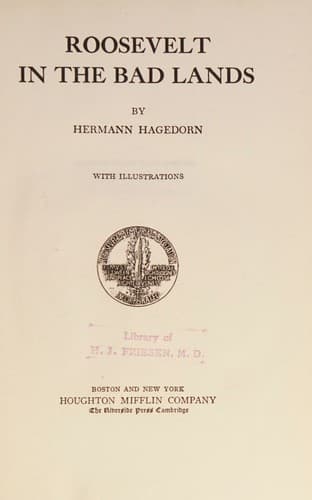
Biography; Frontier and pioneer life -- Dakota Territory; Roosevelt, Theodore, 1858-1919
He managed to persuade Sylvane, somewhat against that individual's
personal judgment (for Sylvane was suspicious of "dudes"), that he
actually intended "to carry his own pack." Sylvane found, to his
surprise, that the "dude" learnt quickly. He showed Roosevelt once how
to saddle his horse, and thereafter Roosevelt saddled his horses
himself. Sylvane was relieved in spirit, and began to look with new
eyes on the "four-eyed tenderfoot" who was entrusting a fortune to his
care.
There was no general round-up in the valley of the Little Missouri
that spring of 1884, for the cattle had not had the opportunity to
wander to any great distance, having been on the range, most of them,
only a few months. The different "outfits," however, held their own
round-ups, at each of which a few hundred cattle might be gathered
from the immediate vicinity, the calves "cut out" and roped and
branded, and turned loose again to wander undisturbed until the "beef
round-up" in the fall.
At each of these round-ups, which might take place on any of a dozen
bottoms up or down the river, the Maltese Cross "outfit" had to be
represented, and Sylvane and Merrifield and George Myers were kept
busy picking up their "strays." Roosevelt rode with them, as "boss"
and at the same time as apprentice. It gave him an opportunity to get
acquainted with his own men and with the cowpunchers of half a dozen
other "outfits." He found the work stirring and the men singularly
human and attractive. They were free and reckless spirits, who did not
much care, it seemed, whether they lived or died; profane youngsters,
who treated him with respect in spite of his appearance because they
respected the men with whom he had associated himself. They came from
all parts of the Union and spoke a language all their own.
"We'll throw over an' camp to-night at the mouth o' Knutson Creek,"
might run the round-up captain's orders. "Nighthawk'll be corralin'
the cavvy in the mornin' 'fore the white crow squeals, so we kin be
cuttin' the day-herd on the bed-groun'. We'll make a side-cut o' the
mavericks an' auction 'em off pronto soon's we git through."
All that was ordinary conversation. When an occasion arose which
seemed to demand a special effort, the talk around the "chuck-wagon"
was so riddled with slang from all corners of the earth, so full of
startling imagery, that a stranger might stare, bewildered, unable to
extract a particle of meaning. And through it blazed such a continual
shower of oaths, that were themselves sparks of satanic poetry, that,
in the phrase of one contemplative cowpuncher, "absodarnnlutely had to
be parted in the middle to hold an extra one."
It was to ears attuned to this rich and racy music that Roosevelt came
with the soft accents of his Harvard English. The cowboys bore up,
showing the tenderfoot the frigid courtesy they kept for "dudes" who
happened to be in company, which made it impolite or inexpedient to
attempt "to make the sucker dance."
Public-domain text, read in full here on John Shaqi.
Reviews
Reviews
No reviews yet
Be the first to share your thoughts on this work.
Elsewhere in the archive
Join the Discussion
Join the discussion
Sign in to leave a comment or review.
Sign InorCreate an account