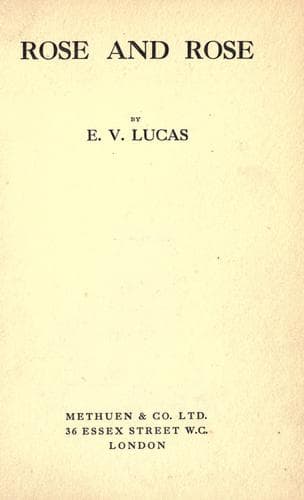
England -- Social life and customs -- Fiction; Guardian and ward -- Fiction; Physicians -- Fiction; Single men -- Fiction
And it was thus that I got away. I had realized directly I heard Rose’s
decision that this was no place for me. I was an interloper. Mother and
daughter must solve their own problems, and solve them alone; they would
be glad to be unobserved as they reconnoitred to ascertain each other’s
position. I have stumbled upon that military phrase, but on second
thoughts I recognize its fitness; for in a sense they were foes, as most
women can be, and mother and daughter too often actually are. How they
would have adjusted their relations had these fourteen estranging years
not intervened, no one could say. They might have been happy; certainly
they would often have been merry and care-free, for that was the natural
tendency of both. Moreover, there might have been an extra bond—I have
seen it often—in mutual refuge from the Master of the House. But between
mothers and daughters a certain hostility, not unconnected with rivalry,
is only too common, if not inevitable. For a mother, be she ever so
sweet-natured and generous and proud of her daughter, is also a woman,
and women love love, and hate the thought of the shelf, and resent the
younger generation’s vista of triumphs. Not until they are much older
than Rose do they consent to retire from the lists, forgive their
successors, and take with serenity to gardening and cards.
* * * * *
Whether or no Rose knew I was lying, I had no notion; but she acquiesced
naturally enough and waved me a wistful good-bye.
I too had plenty to think of as the train bore me Londonwards. For
everything had changed—Rose’s return was a bomb-shell. Had she come back
a day later when her daughter was established in her Hostel and the
London machinery had begun, all would have been simpler. But now? I
knew them both so well—the mother and the daughter equally determined on
any course they undertook: the daughter, after her vigil, so bent upon
sacrifice and capable even of extracting some pleasurable gall from it,
and the mother so unwilling to cool young ardencies and spoil young
hopes.
To which did I owe the greater allegiance? To the mother, of course.
The girl was at the threshold and had youth and enthusiasm and purpose;
the mother was broken and without a star. If the mother would come to
me, how gladly would I open my arms once more! But would she? No. How
could she, knowing what people would say, having to meet the cold eyes of
the rector and his wife, and seeing children withdrawn from her presence?
Wherever she made her home it could not be in my house.
Public-domain text, read in full here on John Shaqi.
Reviews
Reviews
No reviews yet
Be the first to share your thoughts on this work.
Elsewhere in the archive
Join the Discussion
Join the discussion
Sign in to leave a comment or review.
Sign InorCreate an account