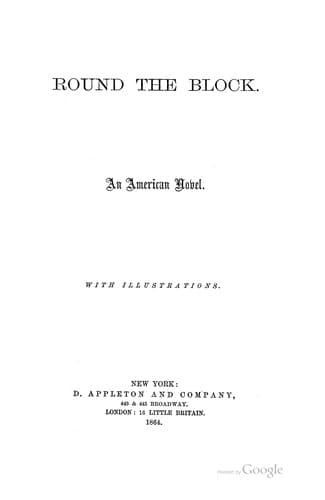
Round the Block: An American NovelBouton, John Bell
General
Round the Block: An American Novel
Bouton, John Bell
City and town life -- Fiction; Male friendship -- Fiction; New York (N.Y.) -- Social life and customs -- Fiction
As to the imputations upon his former history, Marcus could freely
challenge the closest scrutiny; which is more than most men can do into
that long record of juvenile frailties and escapades which ushers in the
sober book of manhood. But here again the devil of sensitiveness
asserted his supremacy. Marcus had had a twin brother (who died years
before), a duplicate of himself in all respects but two. Marcus was
quiet, studious, honest, and frank; while Aurelius was quiet, studious,
less honest, and infinitely crafty. Marcus had, on several occasions in
his boyhood, been accused of petty offences which Aurelius had
committed, but which that cunning youth had unblushingly denied. These,
so far as Marcus supposed, were nothing more serious than robbing
orchards or melon patches. Still it was possible that some graver
wrong--more worthy of the title "infamous"--committed by his wild,
shrewd brother, might be brought to light by some deep explorer among
the traditions of his native village, and charged upon himself. This
possibility, and the difficulty of refuting a serious accusation under
such circumstances, brought a second flush of guilt to the face of
Marcus Wilkeson as he read the letter.
These harassing thoughts, which fill so much space, written out, are but
a small part of those which were suggested with electric suddenness.
Marcus's first impulse was to say: "I love your daughter, Mr. Minford,
with my whole heart and soul. It is my first and my only love, singular
though this confession may sound from the lips of a man of thirty-six
years. The proudest and happiest day of my life would be that on which I
could marry her, with her dear love and your fatherly consent. This
love, which is as pure as the angelic creature upon whom it is lavished,
fully explains my visits here, and whatever else is mysterious in my
conduct. But, before declaring myself to your daughter, or asking her
hand of you, I have desired to see whether it were possible to inspire
her with love for a man so much older than herself. For, much as I love
her, I would not seek to marry her without a return of love--not mere
respect, esteem, or gratitude. That is the problem I have been waiting
to solve."
A confession to this effect was on the tip of his tongue. To have made
it, would have been like tearing open his breast and showing his heart.
But he would have made it, whatever the pain, if, on looking nervously
up from the letter, which he had now finished, he had not met the cold,
searching eyes of the inventor. He instantly shut his lips upon the
outcoming confession, and said, with as much indifference as he could
awkwardly assume:
"I hope, sir, you have taken the trouble to investigate these ridiculous
charges." But Marcus inwardly hoped he had not.
Public-domain text, read in full here on John Shaqi.
Reviews
Reviews
No reviews yet
Be the first to share your thoughts on this work.
Elsewhere in the archive
Join the Discussion
Join the discussion
Sign in to leave a comment or review.
Sign InorCreate an account