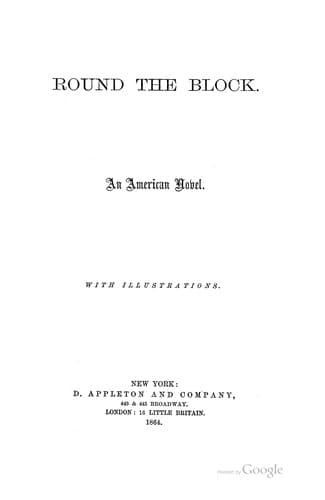
Round the Block: An American NovelBouton, John Bell
General
Round the Block: An American Novel
Bouton, John Bell
City and town life -- Fiction; Male friendship -- Fiction; New York (N.Y.) -- Social life and customs -- Fiction
"The explanation is _plausible_" (Mr. Minford emphasized the word), "and
I will not attempt to set it aside. God alone knows all the motives of
human action. Now, to the second, and more serious implication of the
letter. I have visited your native village, and inquired into your early
history. Though you moved to the city over fifteen years ago, and have
returned to your birthplace but once since, so far as I could
ascertain--"
"Allow me," said Marcus. "My absence from my old home may seem strange,
but it is occasioned by no shame or disgrace. My father, mother, and
twin brother died and were buried there. By my father's failure, shortly
before his death, the old family mansion passed out of his hands, and
was afterward torn down to make room for a railway depot. This
extinction of my family--for I am now left without a relation in the
world, excepting a half-sister--and this destruction of our old home,
have made my native village horrible to me. When I visited the scene of
desolation, ten years ago, the village seemed to me like a huge
graveyard, in every part of which some happiness of my boyhood was
entombed; and I vowed that I would never go near it again. In the matter
of family recollections, I am exquisitely sensitive."
"I respect your feelings, sir," said the inventor, "and regret that I
should be the means of reviving these painful recollections. But I have,
a duty to perform."
"And I will no longer delay you in its performance. Now be kind enough
to let me know the worst at once. I can stand it." Marcus unconsciously
sat up more erect, as if to brace himself against a shock.
"On my arrival in the village, my first act was to seek out some of the
oldest inhabitants. I found that most of them distinctly remembered you,
and your brother--Aurelius, I think, was his name. You will pardon me
for telling you the exact result of my inquiries, but I found that these
old inhabitants, without a single exception, gave you a very bad name,
and your brother a very good one."
Marcus was about to explain, that his brother and himself were images of
each other; that the former was crafty, and full of mischief, and that
he (Marcus) had been made, on fifty occasions, the innocent scapegoat of
his brother's little offences. But he forbore. He had cheerfully
received reprimands, and even chastisements, for his brother while
living; and he would not blacken his memory when dead. He merely smiled
a sad smile, and said, "Ah?"
Public-domain text, read in full here on John Shaqi.
Reviews
Reviews
No reviews yet
Be the first to share your thoughts on this work.
Elsewhere in the archive
Join the Discussion
Join the discussion
Sign in to leave a comment or review.
Sign InorCreate an account