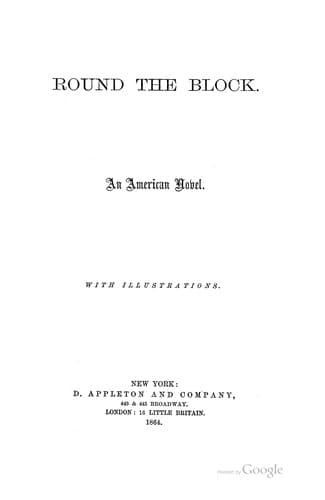
Round the Block: An American NovelBouton, John Bell
General
Round the Block: An American Novel
Bouton, John Bell
City and town life -- Fiction; Male friendship -- Fiction; New York (N.Y.) -- Social life and customs -- Fiction
Mr. Thomas Pigworth, the landlord, was seated on the stoop of his
hostelry, discoursing of national politics to a small group of his
fellow citizens, who were performing acrobatic feats with chairs in a
circle about him. Pigworth was a justice of the peace, and was always
dressed in his best clothes, so as to perform his judicial functions at
a moments notice, with dignity and ease. He was tall, thin, baldheaded.
T.J. Childon, landlord of the "National," said hard things, as in duty
bound, of his rival. Among others, that he had kept himself lean by
running so hard for office for the last ten years. To which slander
Pigworth retorted, that Childon was fat (which was true--a fine, plump
figure was Childon's) only because he ate everything in his house, and
left nothing for his customers.
The three newcomers mounted the rotten wooden steps to the stoop. Mr.
Pigworth left his group of auditors, came forward, and received them
with the affability of a retired statesman.
"The landlord?" asked Tiffles.
"I keep the hotel," said Pigworth, with a smile which intimated that he
kept it for amusement rather than profit.
"Room and board for three of us?" asked Tiffles.
"Certainly," said Pigworth, with the air of a man who was doing them a
favor. "Ef you want only one apartment, I can give you the one occupied
last week by the Hon. Mr. Podhammer. You have heard of him?"
"Of course," responded Tiffles, to cut short the conversation.
"He spoke in Washington Hall, there, on the Cons'tution. He is smart on
some things, but THE CONS'TUTION he doesn't understand--not a word of
it. I told him so."
Tiffles was about to ask why, if the Hon. Mr. Podhammer didn't
understand a word of the Constitution, he had the audacity to lecture on
it; when he remembered that it was no uncommon thing for lecturers to
talk of what they don't understand--himself of Africa, for instance.
"Be good enough to show us the room," said he.
"I say, Judge" (Pigworth, being a justice of the peace, was universally
styled thus), cried a voice from the group, "do you, or do you not,
indorse my sentiments?"
Pigworth turned majestically, and spoke like an oracle:
"I do not indorse your sentiments. I wish it distinctly understood, that
I do not indorse them. I indorse nothing but the Cons'tution. That
instrument I indorse to any extent. Are you satisfied now?"
This speech was hailed by cries of "Good! good!" "That's so!" "Sound
doctrine, that!" "The Judge knows what's what!" Only one person, the
questioner, a young man with a preternatural head, was unappeased.
"A single word more," said this young man. "Do you, or do you not,
subscribe to my views on the Homestead Law?"
Public-domain text, read in full here on John Shaqi.
Reviews
Reviews
No reviews yet
Be the first to share your thoughts on this work.
Elsewhere in the archive
Join the Discussion
Join the discussion
Sign in to leave a comment or review.
Sign InorCreate an account