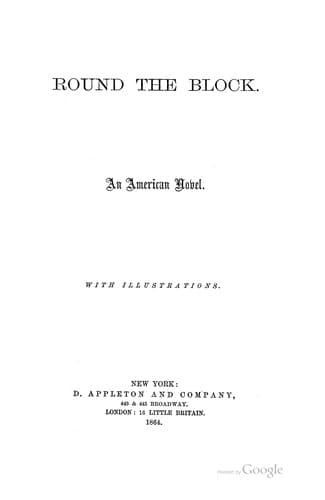
Round the Block: An American NovelBouton, John Bell
General
Round the Block: An American Novel
Bouton, John Bell
City and town life -- Fiction; Male friendship -- Fiction; New York (N.Y.) -- Social life and customs -- Fiction
"Under these circumstances we will go in, though I must confess I expect
to be disappointed. You will excuse my plain speaking." The thick-set
gentleman thereupon thrust a hand into a pocket, and produced--not a
huge roll of bank bills, or a half pint of silver, as Marcus, who eyed
him sharply through the pigeon hole, had expected, but--a card, which he
poked at Tiffles.
Tiffles recognized it at the first glance. It was one of thirty
complimentary tickets that he had caused to be distributed among the
leading men of the village that morning, by advice of the landlord; and
it bore the name of "C. Skimmerhorn, Esq."
"Welcome, sir, welcome!" said Tiffles, as he observed the dollar and a
quarter disappear from his mental horizon, and felt that, but for his
indomitable good nature, he would like to kick C. Skimmerhorn, Esq.,
down stairs. And Tiffles, nobly concealing his disappointment, showed C.
Skimmerhorn, Esq., and his domestic caravan to the best front seat. As
he turned back to the door, he heard that gentleman say to his spouse,
"That fellow looks like a humbug."
A stream of people on the stairs gladdened his eyes. In one sweeping
survey, he figured up three dollars. But they proved to be three
clergymen, with faded wives, large families, and female relatives
stopping with them. Each of the clergymen graciously informed Tiffles,
on delivering up his family ticket, that a panorama was one of the few
secular entertainments that he could consent to patronize. They doubted
very much whether they could have been persuaded to come, but for the
recommendation of their evangelical brethren in the city.
Tiffles bowed acknowledgment of the empty honor, and ushered the three
clergymen and families to the front row of seats, of which C.
Skimmerhorn, Esq., and his train, occupied as much as they could cover
by spreading out. Mr. Skimmerhorn recognized, in one of the clergymen,
his beloved pastor, and proceeded, in a pleasant, off-hand manner, and a
loud voice, to give a few of the reasons which inclined him to pronounce
the panorama a humbug.
"Being deadheads," sarcastically observed Tiffles to Marcus Wilkeson,
"of course they come early, and take the best seats."
The next customer was a poor but jovial mechanic, having a red-faced
little wife slung on his arm. This humble individual paid down fifty
cents in bright new silver to the grim treasurer, entered the hall, and
took seats about halfway up. "It's a splendid affair, Sally, this 'ere
pannyrammer, I'll bet anything." "Sha'n't we enjoy it, John!" returned
that healthy young woman.
More work for the amiable Tiffles, but none for the melancholy
Wilkeson. Two more clergymen with families, the County Judge, the local
railroad agent, all the members of the Board of Freeholders, and several
other people, who, according to the landlord of the United States Hotel,
were highly influential in moulding public opinion, and were in the
habit of receiving free tickets.
Public-domain text, read in full here on John Shaqi.
Reviews
Reviews
No reviews yet
Be the first to share your thoughts on this work.
Elsewhere in the archive
Join the Discussion
Join the discussion
Sign in to leave a comment or review.
Sign InorCreate an account