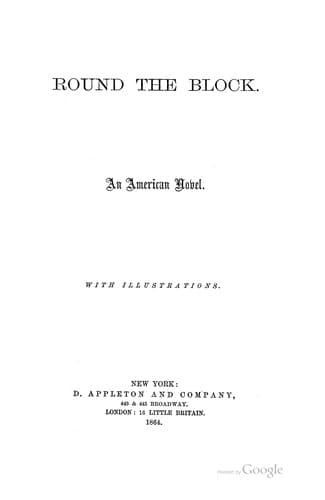
Round the Block: An American NovelBouton, John Bell
General
Round the Block: An American Novel
Bouton, John Bell
City and town life -- Fiction; Male friendship -- Fiction; New York (N.Y.) -- Social life and customs -- Fiction
The keen eyes of the coroner caught these signs, and he immediately
brought in a mental verdict of "guilty." Some of the jury observed the
same signs, and thought them suspicious. The reporters looked upon
Marcus Wilkeson without emotion or prejudgment. They were so accustomed
to seeing murderers, that they regarded them simply as a part of the
business community--a little vicious, perhaps, but not so much worse
than other people, after all. One reporter, attached to an illustrated
paper, dashed off the profile of Marcus Wilkeson, under the cover of his
hat, and caught the dejected expression of his face to a nicety.
CHAPTER II.
STATEMENT OF THE PRISONER.
The coroner received Marcus with that air of consideration which
magistrates instinctively bestow upon persons charged with great crimes,
and informed him, with some respect, that he was brought there to make
any explanation that he saw fit, touching his connection with "this
'ere murder."
The party were then accommodated with seats near the jury, and facing
the reporters. As Marcus looked up, and saw those practised scribes
sharpening their pencils, his heart sank deeper within him. The vision
which had troubled him all night, of a broadside notoriety in all the
city papers, rose before his mind, clothed with fresh horror. The dull
sound of sharpening those pencils was like the whetting of the
executioner's knife.
The proper course was to have accepted an unsworn statement from the
prisoner; but the coroner always administered oaths when prisoners were
willing to take them. The repetition of that jargon with a profane
conclusion (for so it seemed, in the slipshod way that it was said),
which the coroner called an oath, was a positive pleasure to that
official. As Marcus desired to take the oath, the coroner rattled off
the unintelligible something, and handed him a Bible, which the prisoner
pressed reverentially to his lips. Marcus, being now supposed to be
sworn, proceeded, with what firmness he could muster, to answer the
numerous interrogatories of the coroner. That official chewed hard, and,
as it were, spit out his questions.
His testimony, in substance, was this:
That he was a friend of the deceased, and had loaned him one thousand
dollars to complete a machine upon which he was engaged--pointing to the
unfinished pile in the corner. That his relations with the deceased and
his family (Marcus did not like to mention Pet's name) were entirely
agreeable, until an anonymous letter, charging him with improper motives
in visiting the house, had poisoned the mind of the deceased against
him. [The giving up of this letter to the coroner, who read it to the
jury, and then tossed it over to the reporters for copying, was a hard
trial, but Marcus had resolved upon meeting all the troubles of the
case halfway.]
Public-domain text, read in full here on John Shaqi.
Reviews
Reviews
No reviews yet
Be the first to share your thoughts on this work.
Elsewhere in the archive
Join the Discussion
Join the discussion
Sign in to leave a comment or review.
Sign InorCreate an account