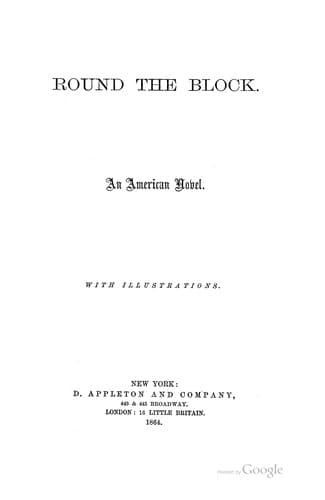
Round the Block: An American NovelBouton, John Bell
General
Round the Block: An American Novel
Bouton, John Bell
City and town life -- Fiction; Male friendship -- Fiction; New York (N.Y.) -- Social life and customs -- Fiction
The old man listened sadly and quietly; only now and then interrupting
the boy's narrative with questions that were seemingly as calm as a
judge's interrogatories.
"He is a murderer. Something in the air tells me that he is," murmured
the old man. "And he is my son."
The inexpressible heart-broken sadness, with which he uttered these
words, brought tears to the eyes of his hearers.
"It may be, my dear Mr. Van Quintem, that your son did not write the
anonymous letters to Mr. Minford, notwithstanding the point of
resemblance which we think we have detected. While sitting, at my
window, I have often noticed him in his room scribbling at a desk, as if
he were practising penmanship. Perhaps, if you examine the contents of
the desk, you may get some further light on the subject. It is
wonderful--most people would say impossible--that a man should write
two letters so entirely dissimilar as these."
"My son always excelled in writing. It was one of the branches that he
took prizes in at school. I will examine the desk; but I fear I shall
only confirm my strong suspicions that he is a murderer. O God! O God!
Why did he not die with his sainted mother! Far better would that have
been. It is a hard thing, gentlemen--it is a very hard thing; but if
this boy of mine does not surrender himself to the hands of justice
to-morrow, I shall--I shall--myself denounce him to the--"
The afflicted man, overcome with the terrible conflict between a sense
of public duty, and a lingering, inextinguishable parental affection,
fainted and fell into the arms of Marcus, who sprang to catch him.
While he was still insensible, the lieutenant of police, and the boy
Bog, slipped out of the room, and started off on a search for Myndert
Van Quintem, jr.
CHAPTER VI.
WHAT PAPER, TYPES, AND INK CAN DO.
When Marcus and his counsel, accompanied by the faithful lieutenant of
police, arrived in a close carriage at the scene of the inquest, at the
hour of adjournment next morning, they saw a convincing illustration of
the power of paper, types, and ink.
The morning journals, with whole leaded pages of evidence, and new
diagrams of the house and fatal room; and the enterprising illustrated
weekly, with portraits of the deceased, the prisoner, his counsel,
Tiffles, Patching (great hat and all), Patty Minford, the coroner, the
foreman of the jury, a full-page design of the murder, as it was
supposed to have taken place, representing the infuriate Wilkeson, club
in hand, standing over the prostrate body of the inventor, from whose
forehead the gore was pouring in torrents--all these delightful,
provocatives of sensation had done their full and perfect work.
At that moment, Marcus Wilkeson was known to the world of readers in New
York and the whole country round about, as the murderer of
Eliphalet Minford.
Public-domain text, read in full here on John Shaqi.
Reviews
Reviews
No reviews yet
Be the first to share your thoughts on this work.
Elsewhere in the archive
Join the Discussion
Join the discussion
Sign in to leave a comment or review.
Sign InorCreate an account