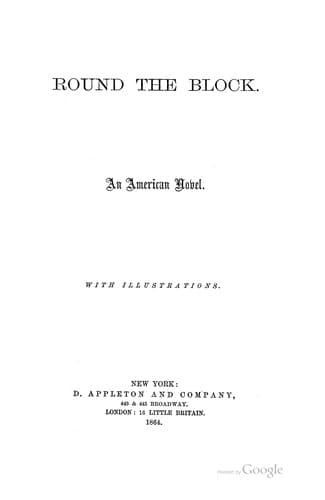
Round the Block: An American NovelBouton, John Bell
General
Round the Block: An American Novel
Bouton, John Bell
City and town life -- Fiction; Male friendship -- Fiction; New York (N.Y.) -- Social life and customs -- Fiction
The firm of Overtop & Maltboy had recently come into a small but paying
business, in this way: The release of Marcus Wilkeson was generally
supposed to have been effected, not by his innocence, but by the skilful
and professional, but unprincipled efforts of his legal advisers. Their
name was not unfavorably known among the thieves and murderers of the
city; and several individuals belonging to those classes of society
resolved to employ them when they got into their next little difficulty.
And, since the inquest, another thing had greatly contributed to the
prosperity of the firm. We allude to the case of Slapman _vs_. Slapman.
This was an action for divorce, with alimony, brought by Mrs. Grazella
Jigbee Slapman against her husband, Ferdinand P. Slapman. The ground
upon which the separation was sought, was the continual brutality of Mr.
Slapman toward his wife.
It was the law and the custom, in cases where both parties to the action
were agreed to that arrangement, to turn over this species of litigation
to a referee, who took the testimony in private, heard arguments of
counsel, and rendered a decision subject to the confirmation of the
Supreme Court. The Court had issued a standing order prohibiting all
persons from publishing (except with the consent of the parties to the
action) any further reports of the cases than a simple announcement of
the decree, as confirmed by the Court, for or against a divorce. This
order was put forth to protect the public from the contaminating example
of matrimonial infelicities; though we are not aware that the number of
divorce cases has materially decreased, or the standard of public
morality been greatly elevated in consequence thereof.
The case of Slapman _vs_. Slapman was on trial before a referee, by
mutual agreement of the parties. The newspapers did not report it; but
some of them kept hinting at it in an appetizing way. The gentleman
whose "gallantry, &c.," was the "remote cause of the action," was
described as "a rising young lawyer, who distinguished himself in a
recent inquest before Coroner ----, the thrilling particulars of which
are still fresh in the minds of our readers;" or as a "young ornament of
the legal profession, whose office was not a hundred miles from the
corner of Broadway and ---- street" (the precise location of his
office). One paper went so far as to say, that the "triumph which this
disciple of Coke had achieved in the late _cause celebre_, was only to
be equalled by his invariable success in affairs of the heart, &c., &c."
All this caused Fayette Overtop's name to be known by thousands of
people. Persons who were seeking divorces, reasoned, strangely enough,
that a man whose "gallantry, &c.," was the cause of a divorce, could
materially assist them in severing the matrimonial bonds. Therefore they
began to flock to him. He already had five female and two male clients
of this description.
Public-domain text, read in full here on John Shaqi.
Reviews
Reviews
No reviews yet
Be the first to share your thoughts on this work.
Elsewhere in the archive
Join the Discussion
Join the discussion
Sign in to leave a comment or review.
Sign InorCreate an account