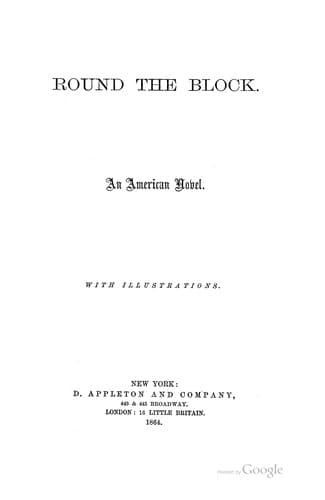
Round the Block: An American NovelBouton, John Bell
General
Round the Block: An American Novel
Bouton, John Bell
City and town life -- Fiction; Male friendship -- Fiction; New York (N.Y.) -- Social life and customs -- Fiction
Then he lighted his meerschaum, closed the window, squared his chair in
front of it, and looked out. His face instantly flushed with pleasure at
a strange sight. The blinds of the lower parlor windows across the way,
which had been shut for several weeks, were now thrown open, and the
white-haired old gentleman, looking thin and pale, sat in his armchair
in his old place, and was gazing at him. At least so Marcus thought; but
he hesitated to bow until the old gentleman gave a distinct salutation.
Marcus returned it two or three times with emphasis, as if to express
his great pleasure at seeing his unknown neighbor and friend again. He
blushed as he did so, for he was conscious of wilful neglect and cruel
indifference, in not having called upon him on New Year's day, or since
then, during the period of the closed blinds; and worse still, in not
having thought of him a dozen times, though he had taken the trouble to
pass his door on his way to or from Mr. Minford's, and had felt relieved
to see no black crape on the bell-pull.
"But then," thought Marcus, pleading with and for himself, "my mind has
been occupied--very much occupied--- with other matters. Now, if he
beckons to me again, I will go over to him without a moment's delay. My
old friend looks very sick and unhappy."
Just then the old gentleman reached out his thin white hand, as if the
motion required an effort, and beckoned twice. Marcus answered with two
bows, and immediately rose, and laid down his pipe on the window sill,
thereby implying that he would come over at once. The old gentleman
smiled faintly, to express his delight.
In a few minutes Marcus Wilkeson stood at the antique mansion, and
pulled the bell. It vibrated feebly as if it shared with the house and
its owner the infirmities of age. The bell was answered by an old,
neatly dressed female servant. She had been told to admit the caller
instantly, and said, "Mr. Van Quintem will see you, sir."
He entered a wide hallway, and followed the noiseless step of the
servant, trying to remember, without success, where he had heard the
name of Van Quintem.
At the end of the hall the servant opened a door, and ushered him into a
room decorated at the edges of the ceiling with heavy wooden carvings,
and furnished in the style of the last century. The old gentleman partly
rose from his soft armchair, supported himself by one hand on it, and
extended the other to his visitor.
"My name is Myndert Van Quintem, sir," said he, "and I am very glad to
see you." There was a pleasant smile in the old gentleman's pale face,
and a warmth in the grasp of his thin right hand, that attested the
sincerity of his words.
"And my name is Marcus Wilkeson, sir; and I am truly happy to make your
acquaintance," responded the visitor, in his most genial manner.
The old gentleman here showed symptoms of faintness from the exertion of
standing; and Marcus, taking him by the arm, forced him gently into his
easy chair, and took a seat beside him.
Public-domain text, read in full here on John Shaqi.
Reviews
Reviews
No reviews yet
Be the first to share your thoughts on this work.
Elsewhere in the archive
Join the Discussion
Join the discussion
Sign in to leave a comment or review.
Sign InorCreate an account