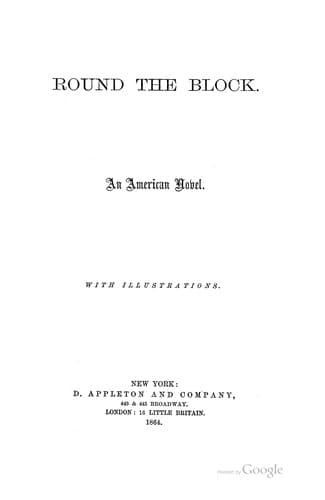
Round the Block: An American NovelBouton, John Bell
General
Round the Block: An American Novel
Bouton, John Bell
City and town life -- Fiction; Male friendship -- Fiction; New York (N.Y.) -- Social life and customs -- Fiction
"Not more closely than I have observed you," said Marcus. "I have often
wondered what stout old quartos you were reading. To tell you the truth,
I inferred, from the dimensions of the books and your white cravat, that
you were a clergyman." Marcus might have added, that the old gentleman's
flowing white locks and benevolent features had contributed to the
illusion; but he had already discovered that Mr. Van Quintem, like
himself, was averse to compliments.
The old gentleman took the remark good-naturedly. "This is not the first
time," said he, "that my old-fashioned fancy for a white cravat has led
to that mistake. You will find very little of the body of divinity in
that library. When I recover from this illness so as to hobble about, we
will look over my little collection together."
Marcus said that nothing could give him greater delight, unless it was
to show his friend his own humble library.
"Thank you," returned Mr. Van Quintem; "and I promise to run over and
look at it when I am well enough to go out." The haste with which the
old gentleman made the last remark, and the fact that he did not invite
his visitor to examine the library then and there, led Marcus to think
that the old gentleman had some private trouble on his mind, which he
wished to diminish by imparting to another. Marcus was right.
The old gentleman heaved a sigh, and resumed:
"For ten years after my retirement, my wife and I lived on in the calm,
happy manner that I have described. We had no griefs--not even that one
which most commonly afflicts parents, the loss of children. Yet I
sometimes think, sir, that it would be far better for some children to
die in their youth and innocence, than to grow up and become bad men,
and torture and almost kill their parents with ingratitude and
unkindness." Marcus guessed what was to come.
"We had but one child--a boy--born long after I had given up all hopes
of having an heir. I need not tell you, sir, what a joy he was to us in
his infancy; for you, too, I presume, are a husband and a father."
Marcus replied confusedly, and as if it were something to be ashamed of,
that he was neither the one nor the other, though he hoped some day
(here he was exceedingly awkward) to be both.
The old gentleman was so wrapped up in his own thoughts, that he did not
seem to notice the reply. He again braced himself in the chair, as if he
would, by that act, gather strength to proceed.
"Of course, I called the child Myndert. He was the seventh of that name;
and I used to think, even when he was a toddling little baby, what plans
of education would be best suited to develop his talents. I know that a
parent's partiality is a magnifying glass of high power; but, to the
best of my belief, he was a most precocious child. I think so now, as I
look back upon the days of his prattling innocence.
Public-domain text, read in full here on John Shaqi.
Reviews
Reviews
No reviews yet
Be the first to share your thoughts on this work.
Elsewhere in the archive
Join the Discussion
Join the discussion
Sign in to leave a comment or review.
Sign InorCreate an account