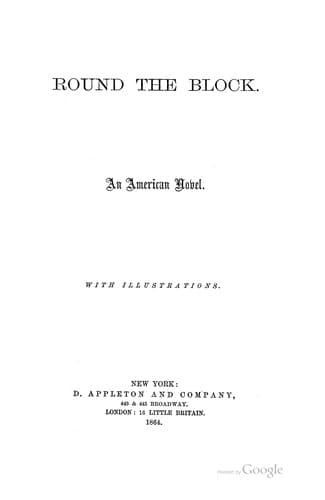
Round the Block: An American NovelBouton, John Bell
General
Round the Block: An American Novel
Bouton, John Bell
City and town life -- Fiction; Male friendship -- Fiction; New York (N.Y.) -- Social life and customs -- Fiction
From boyhood, it had been Marcus Wilkeson's fortune (or the reverse) to
attract confidence, and to be sought out for advice. And it had most
generally happened that he was requested to bestow the last valuable
article in cases where inexperience absolutely disqualified him from
giving it.
He had found, however, that, when people ask for advice, they expect to
receive it, although they reserve to themselves the right, and, in
ninety-nine cases out of a hundred, exercise the privilege, of
rejecting it.
But Marcus had gathered, from the old gentleman's story, that the error
of his dealings with the rebellious son lay in his constantly seeking
advice from everybody, and taking it, too, instead of adopting some
firm, consistent, and independent course of his own toward that unfilial
monster. Furthermore, Marcus knew that the son was already beyond the
reach of reform. For the future peace of his venerable friend, and for
the good of society, he could have conscientiously recommended
two things:
First, the immediate hanging of Myndert Van Quintem, jr. Second, his
imprisonment for life in a penitentiary warranted to be strong enough
to hold him.
Neither of these courses being practicable until that young man had
entitled himself to the benefit of one or the other of them in the
legitimate way, Marcus Wilkeson had nothing to offer, and so he told the
old gentleman.
Mr. Van Quintem was disappointed. He looked up wistfully, and said:
"Can't you suggest something?"
Thus appealed to, Marcus angled in the deep waters of his mind, and
fished up this inadequate idea:
"Let him travel a couple of years in Europe."
"I have proposed it," returned the old gentleman, "but he won't, unless
I give him five thousand dollars, and an unlimited letter of credit.
This I refused. Besides, to tell the truth, I do not wish to exile the
boy, but to reform him at home."
Marcus was too polite to say bluntly that that was impossible; so he
cast in his line again at random, and drew out this worthless
suggestion:
"Stop all his pocket money, and tell him plainly that you will
disinherit him unless he reforms."
"My dear sir," replied the old gentleman, "that might do with some sons,
but not with mine. He would obtain money by theft, or even a worse
crime, and bring disgrace upon my gray hairs. He might go even
farther--for he has threatened it, as I told you--and murder me in
revenge. Besides, he is on short allowance now. I give him only thirty
dollars a week--less than a quarter of what he used to receive from me.
Much as his conduct deserves punishment, I could not reduce him to
beggary, you know."
Public-domain text, read in full here on John Shaqi.
Reviews
Reviews
No reviews yet
Be the first to share your thoughts on this work.
Elsewhere in the archive
Join the Discussion
Join the discussion
Sign in to leave a comment or review.
Sign InorCreate an account