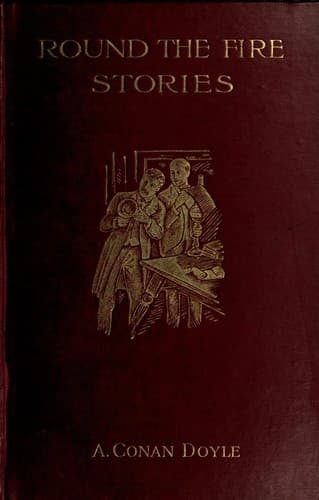
English fiction; Horror tales, English; Short stories, English
Amongst the many suggestions put forward by various newspapers or
private individuals, there were one or two which were feasible enough to
attract the attention of the public. One which appeared in the _Times_,
over the signature of an amateur reasoner of some celebrity at that
date, attempted to deal with the matter in a critical and
semi-scientific manner. An extract must suffice, although the curious
can see the whole letter in the issue of the 3rd of July.
“It is one of the elementary principles of practical reasoning,” he
remarked, “that when the impossible has been eliminated the residuum,
_however improbable_, must contain the truth. It is certain that the
train left Kenyon Junction. It is certain that it did not reach Barton
Moss. It is in the highest degree unlikely, but still possible, that it
may have taken one of the seven available side lines. It is obviously
impossible for a train to run where there are no rails, and, therefore,
we may reduce our improbables to the three open lines, namely, the
Carnstock Iron Works, the Big Ben, and the Perseverance. Is there a
secret society of colliers, an English _camorra_, which is capable of
destroying both train and passengers? It is improbable, but it is not
impossible. I confess that I am unable to suggest any other solution. I
should certainly advise the company to direct all their energies towards
the observation of those three lines, and of the workmen at the end of
them. A careful supervision of the pawnbrokers’ shops of the district
might possibly bring some suggestive facts to light.”
The suggestion coming from a recognized authority upon such matters
created considerable interest, and a fierce opposition from those who
considered such a statement to be a preposterous libel upon an honest
and deserving set of men. The only answer to this criticism was a
challenge to the objectors to lay any more feasible explanation before
the public. In reply to this two others were forthcoming (_Times_, July
7th and 9th). The first suggested that the train might have run off the
metals and be lying submerged in the Lancashire and Staffordshire Canal,
which runs parallel to the railway for some hundreds of yards. This
suggestion was thrown out of court by the published depth of the canal,
which was entirely insufficient to conceal so large an object. The
second correspondent wrote calling attention to the bag which appeared
to be the sole luggage which the travellers had brought with them, and
suggesting that some novel explosive of immense and pulverizing power
might have been concealed in it. The obvious absurdity, however, of
supposing that the whole train might be blown to dust while the metals
remained uninjured reduced any such explanation to a farce. The
investigation had drifted into this hopeless position when a new and
most unexpected incident occurred.
Public-domain text, read in full here on John Shaqi.
Reviews
Reviews
No reviews yet
Be the first to share your thoughts on this work.
Elsewhere in the archive
Join the Discussion
Join the discussion
Sign in to leave a comment or review.
Sign InorCreate an account