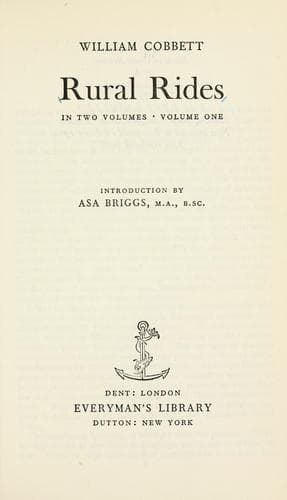
Great Britain -- Description and travel; Great Britain -- Rural conditions
Even the Ministers themselves, if they were so disposed (and
they must be so disposed at last) could make none of the reforms that
are necessary, _without being actually urged on by the middle classes of
the community_. This is a very important consideration. A new man, as
Minister, might indeed propose the reforms himself; but these men,
Opposition as well as Ministry, are so _pledged_ to the things that have
brought all this ruin upon the country, that they absolutely stand in
need of an overpowering call from the people to justify them in doing
that which they themselves may think just, and which they may know to be
necessary for the salvation of the country. They dare not take the lead
in the necessary reforms. It is too much to be expected of any men upon
the face of the earth, pledged and situated as these Ministers are; and
therefore, unless the people will do their duty, they will have
themselves, and only themselves, to thank for their ruin, and for that
load of disgrace, and for that insignificance worse than disgrace which
seems, after so many years of renown, to be attaching themselves to the
name of England.
_Uphusband, Sunday Evening, 29 Sept. 1822._
We came along the turnpike-road, through Wherwell and Andover, and got
to this place about 2 o'clock. This country, except at the village and
town just mentioned, is very open, a thinnish soil upon a bed of chalk.
Between Winchester and Wherwell we came by some hundreds of acres of
ground that was formerly most beautiful down, which was broken up in
dear-corn times, and which is now a district of thistles and other
weeds. If I had such land as this I would soon make it down again. I
would for once (that is to say if I had the money) get it quite clean,
prepare it as for sowing turnips, get the turnips if possible, feed them
off early, or plough the ground if I got no turnips; sow thick with
Saint-foin and meadow-grass seeds of all sorts, early in September; let
the crop stand till the next July; feed it then slenderly with sheep,
and dig up all thistles and rank weeds that might appear; keep feeding
it, but not too close, during the summer and the fall; and keep on
feeding it for ever after as a down. The Saint-foin itself would last
for many years; and as it disappeared, its place would be supplied by
the grass; that sort which was most congenial to the soil, would at last
stifle all other sorts, and the land would become a valuable down as
formerly.
Public-domain text, read in full here on John Shaqi.
Reviews
Reviews
No reviews yet
Be the first to share your thoughts on this work.
Elsewhere in the archive
Join the Discussion
Join the discussion
Sign in to leave a comment or review.
Sign InorCreate an account