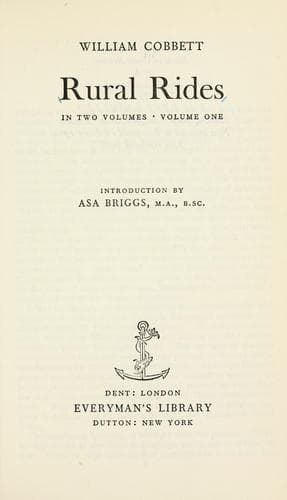
Great Britain -- Description and travel; Great Britain -- Rural conditions
Ever since the middle of March I have been trying remedies for the
_hooping-cough_, and have, I believe, tried everything, except riding,
wet to the skin, two or three hours amongst the clouds on the South
Downs. This remedy is now under trial. As Lord Liverpool said, the other
day, of the Irish Tithe Bill, it is "under experiment." I am treating my
disorder (with better success, I hope) in somewhat the same way that the
pretty fellows at Whitehall treat the disorders of poor Ireland. There
is one thing in favour of this remedy of mine, I shall _know_ the effect
of it, and that, too, in a short time. It rained a little last night. I
got off from Petworth without baiting my horse, thinking that the
weather looked suspicious; and that St. Swithin meaned to treat me to a
dose. I had no great-coat, nor any means of changing my clothes. The
hooping-cough made me anxious; but I had fixed on going along the South
Downs from Donnington Hill down to Lavant, and then to go on the flat to
the South foot of Portsdown Hill, and to reach Fareham to-night. Two
men, whom I met soon after I set off, assured me that it would not rain.
I came on to Donnington, which lies at the foot of that part of the
South Downs which I had to go up. Before I came to this point, I crossed
the Arun and its canal again; and here was another place of deposit for
timber, lime, coals, and other things. White, in his history of
Selborne, mentions a hill, which is one of the Hindhead group, from
which two springs (one on each side of the hill) send water into the
_two seas_: the _Atlantic_ and the _German Ocean_! This is big talk: but
it is a fact. One of the streams becomes the _Arun_, which falls into
the Channel; and the other, after winding along amongst the hills and
hillocks between Hindhead and Godalming, goes into the river _Wey_,
which falls into the Thames at Weybridge. The soil upon leaving
Petworth, and at Petworth, seems very good; a fine deep loam, a sort of
mixture of sand and soft chalk. I then came to a sandy common; a piece
of ground that seemed to have no business there; it looked as if it had
been tossed from Hindhead or Blackdown. The common, however, during the
rage for "improvements," has been _enclosed_. That impudent fellow, Old
Rose, stated the number of Enclosure Bills as an indubitable proof of
"national prosperity." There was some _rye_ upon this common, the sight
of which would have gladdened the heart of Lord Liverpool. It was, in
parts, not more than eight inches high. It was ripe, and, of course, the
straw dead; or I should have found out the owner, and have bought it to
make _bonnets_ of! I defy the Italians to grow worse rye than this. The
reader will recollect that I always said that we could grow _as poor_
corn as any Italians that ever lived. The village of Donton lies at the
foot of one of these great chalk ridges which are called the South
Downs. The ridge in this place is, I think, about three-fourths of a
Public-domain text, read in full here on John Shaqi.
Reviews
Reviews
No reviews yet
Be the first to share your thoughts on this work.
Elsewhere in the archive
Join the Discussion
Join the discussion
Sign in to leave a comment or review.
Sign InorCreate an account