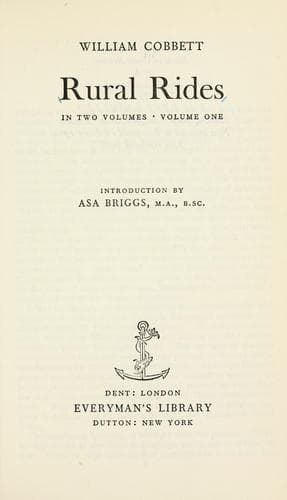
Great Britain -- Description and travel; Great Britain -- Rural conditions
At the end of this tract we come to a spot called Whiteflood, and here
we cross the old turnpike road which leads from Winchester to Gosport
through Bishop's Waltham. Whiteflood is at the foot of the first of a
series of hills over which you come to get to the top of that lofty
ridge called Morning Hill. The farmer came to the top of the first hill
along with me; and he was just about to turn back, when I, looking away
to the left, down a valley which stretched across the other side of the
down, observed a rather singular appearance, and said to the farmer,
"What is that coming up that valley? is it smoke, or is it a cloud?" The
day had been very fine hitherto; the sun was shining very bright where
we were. The farmer answered, "Oh, it's smoke; it comes from Ouselberry,
which is down in that bottom behind those trees." So saying, we bid each
other good day; he went back, and I went on. Before I had got a hundred
and fifty yards from him, the cloud which he had taken for the
Ouselberry smoke came upon the hill and wet me to the skin. He was not
far from the house at Whiteflood; but I am sure that he could not
entirely escape it. It is curious to observe how the clouds sail about
in the hilly countries, and particularly, I think, amongst the
chalk-hills. I have never observed the like amongst the sand-hills, or
amongst rocks.
From Whiteflood you come over a series of hills, part of which form a
rabbit-warren called Longwood warren, on the borders of which is the
house and estate of Lord Northesk. These hills are amongst the most
barren of the downs of England; yet a part of them was broken up during
the rage for improvements; during the rage for what empty men think was
an augmenting of the _capital_ of the country. On about twenty acres of
this land, sown with wheat, I should not suppose that there would be
twice twenty bushels of grain! A man must be mad, or nearly mad, to sow
wheat upon such a spot. However, a large part of what was enclosed has
been thrown out again already, and the rest will be thrown out in a very
few years. The down itself was poor; what, then, must it be as
corn-land! Think of the destruction which has here taken place. The
herbage was not good, but it was something; it was something for every
year, and without trouble. Instead of grass it will now, for twenty
years to come, bear nothing but that species of weeds which is hardy
enough to grow where the grass will not grow. And this was "augmenting
the capital of the nation." These new enclosure-bills were boasted of by
George Rose and by Pitt as proofs of national prosperity! When men in
power are ignorant to this extent, who is to expect anything but
consequences such as we now behold.
Public-domain text, read in full here on John Shaqi.
Reviews
Reviews
No reviews yet
Be the first to share your thoughts on this work.
Elsewhere in the archive
Join the Discussion
Join the discussion
Sign in to leave a comment or review.
Sign InorCreate an account