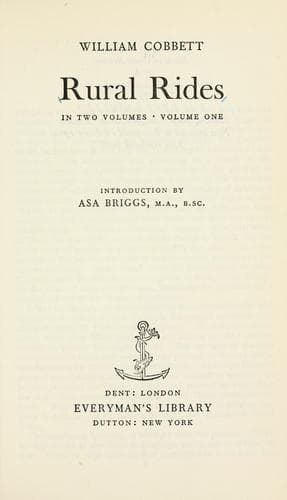
Great Britain -- Description and travel; Great Britain -- Rural conditions
publish it. This is, as he himself states, the best possible proof that
he was unconscious of any error or any deficiency. The fact appears to
be this; that Mr. Hollis, who has for many years been Under Sheriff as
well as Treasurer of the County, who holds several other offices, and
who has, besides, had large pecuniary transactions with his bankers, has
for years had his accounts so blended that he has not known how this
money belonging to the county stood. His own statement shows that it was
all a mass of confusion. The errors, he says, have arisen entirely from
the negligence of his clerks, and from causes which produced a confusion
in his accounts. This is the fact; but he has been in good fat offices
too long not to have made a great many persons think that his offices
would be better in _their_ hands; and they appear resolved to oust him.
I, for my part, am glad of it; for I remember his coming up to me in the
Grand Jury Chamber, just after the people at St. Stephen's had passed
Power-of-Imprisonment Bill in 1817; I remember his coming up to me as
the Under Sheriff of Willis, the man that we now call Flemming, who has
_begun_ to build a house at North Stoneham; I remember his coming up to
me, and with all the base sauciness of a thorough-paced Pittite,
_telling me to disperse or he would take me into custody_! I remember
this of Mr. Hollis, and I am therefore glad that calamity has befallen
him; but I must say that after reading his own account of the matter;
after reading the debate of the Magistrates; and after hearing the
observations and opinions of well-informed and impartial persons in
Hampshire who dislike Mr. Hollis as much as I do; I must say that I
think him perfectly clear of all intention to commit anything like
fraud, or to make anything worthy of the name of false account; and I am
convinced that this affair, which will now prove extremely calamitous to
him, might have been laughed at by him at the time when wheat was
fifteen shillings a bushel. This change in the affairs of the
Government; this penury now experienced by the Pittites at Whitehall,
reaches, in its influence, to every part of the country. The Barings are
now the great men in Hampshire. They were not such in the days of George
Rose while George was able to make the people believe that it was
necessary to give their money freely to preserve the "blessed comforts
of religion." George Rose would have thrown his shield over Mr. Hollis;
his broad and brazen shield. In Hampshire the _Bishop_, too, is changed.
The present is doubtless as pious as the last, every bit; and has the
same Bishop-like views; but it is not the same family; it is not the
Garniers and Poulters and Norths and De Grays and Haygarths; it is not
precisely the same set who have the power in their hands. Things,
therefore, take another turn. The Pittite jolter-heads are all
broken-backed; and the Barings come forward with their well-known weight
of metal. It was exceedingly unfortunate for Mr.
Public-domain text, read in full here on John Shaqi.
Reviews
Reviews
No reviews yet
Be the first to share your thoughts on this work.
Elsewhere in the archive
Join the Discussion
Join the discussion
Sign in to leave a comment or review.
Sign InorCreate an account