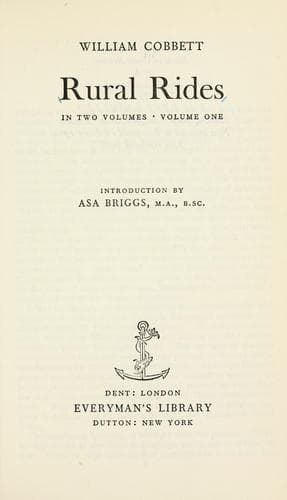
Great Britain -- Description and travel; Great Britain -- Rural conditions
At Ropley Dean, before I mounted the hill to come on towards Rotherham
Park, I baited my horse. Here the ground is precisely like that at
Ashmansworth on the borders of Berkshire, which, indeed, I could see
from the ground of which I am now speaking. In coming up the hill, I had
the house and farm of Mr. Duthy to my right. Seeing some very fine
Swedish turnips, I naturally expected that they belonged to this
gentleman, who is Secretary to the Agricultural Society of Hampshire;
but I found that they belonged to a farmer Mayhew. The soil is, along
upon this high land, a deep loam, bordering on a clay, red in colour,
and pretty full of large, rough, yellow-looking stones, very much like
some of the land in Huntingdonshire; but here is a bed of chalk under
this. Everything is backward here. The wheat is perfectly green in most
places; but it is everywhere pretty good. I have observed, all the way
along, that the wheat is good upon the stiff, strong land. It is so
here; but it is very backward. The greater part of it is full three
weeks behind the wheat under Portsdown Hill. But few farmhouses come
within my sight along here; but in one of them there was a wheat-rick,
which is the third I have seen since I quitted the Wen. In descending
from this high ground, in order to reach the village of East Tisted,
which lies on the turnpike road from the Wen to Gosport through Alton, I
had to cross Rotherham Park. On the right of the park, on a bank of land
facing the north-east, I saw a very pretty farmhouse, having everything
in excellent order, with fine corn-fields about it, and with a
wheat-rick standing in the yard. This farm, as I afterwards found,
belongs to the owner of Rotherham Park, who is also the owner of East
Tisted, who has recently built a new house in the park, who has quite
metamorphosed the village of Tisted within these eight years, who has,
indeed, really and truly improved the whole country just round about
here, whose name is Scot, well known as a brickmaker at North End,
Fulham, and who has, in Hampshire, supplanted a Norman of the name of
Powlet. The process by which this transfer has taken place is visible
enough, to all eyes but the eyes of the jolterheads. Had there been no
Debt created to crush liberty in France and to keep down reformers in
England, Mr. Scot would not have had bricks to burn to build houses for
the Jews and jobbers and other eaters of taxes; and the Norman Powlet
would not have had to pay in taxes, through his own hands and those of
his tenants and labourers, the amount of the estate at Tisted, first to
be given to the Jews, jobbers, and tax-eaters, and then by them to be
given to "'Squire Scot" for his bricks. However, it is not 'Squire Scot
who has assisted to pass laws to make people pay double toll on a
Sunday. 'Squire Scot had nothing to do with passing the New Game-laws
and Old Ellenborough's Act; 'Squire Scot never invented the New Trespass
Public-domain text, read in full here on John Shaqi.
Reviews
Reviews
No reviews yet
Be the first to share your thoughts on this work.
Elsewhere in the archive
Join the Discussion
Join the discussion
Sign in to leave a comment or review.
Sign InorCreate an account