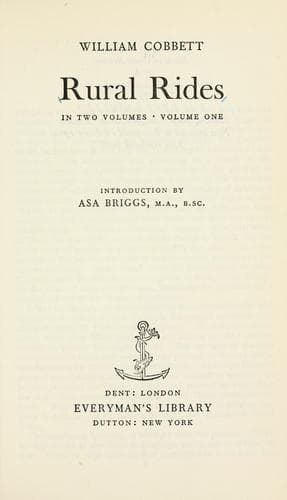
Great Britain -- Description and travel; Great Britain -- Rural conditions
Thus I have concluded this "rural ride," from the Wen and back again to
the Wen, being, taking in all the turnings and windings, as near as can
be, two hundred miles in length. My objects were to ascertain the state
of the crops, both of hops and of corn. The hop-affair is soon settled,
for there will be no hops. As to the corn, my remark is this: that on
all the clays, on all the stiff lands upon the chalk; on all the rich
lands, indeed, but more especially on all the stiff lands, the wheat is
as good as I recollect ever to have seen it, and has as much straw. On
all the light lands and poor lands the wheat is thin, and, though not
short, by no means good. The oats are pretty good almost everywhere; and
I have not seen a bad field of barley during the whole of my ride;
though there is no species of soil in England, except that of the fens,
over which I have not passed. The state of the farmers is much worse
than it was last year, notwithstanding the ridiculous falsehoods of the
London newspapers, and the more ridiculous delusion of the jolterheads.
In numerous instances the farmers, who continue in their farms, have
ceased to farm for themselves, and merely hold the land for the
landlords. The delusion caused by the rise of the price of corn has
pretty nearly vanished already; and if St. Swithin would but get out of
the way with his drippings for about a month, this delusion would
disappear, never to return. In the meanwhile, however, the London
newspapers are doing what they can to keep up the delusion; and in a
paper called _Bell's Weekly Messenger_, edited, I am told, by a
place-hunting lawyer; in that stupid paper of this day I find the
following passage:--"So late as January last, the average price of wheat
was 39_s._ per quarter, and on the 29th ult. it was above 62_s._ As it
has been rising ever since, it may _now be quoted as little under 65s._
So that in this article alone there is a rise of more than _thirty-five_
per cent. Under these circumstances, it is not likely that we shall hear
anything of _agricultural distress_. A writer of considerable talents,
but no prophet, had _frightened_ the kingdom by a confident prediction
that wheat, after the 1st of May, would sink to 4_s._ per bushel, and
that under the effects of Mr. Peel's Bill, and the payments in cash by
the Bank of England, it would _never again exceed that price_! Nay, so
assured was Mr. Cobbett of the mathematical certainty of his deductions
on the subject, that he did not hesitate to make use of the following
language: 'And farther, if what I say do not come to pass, I will give
any one leave to broil me on a gridiron, and for that purpose I will get
one of the best gridirons I can possibly get made, and it shall be hung
out as near to my premises as possible, in the Strand, so that it shall
be seen by everybody as they pass along.' The 1st of May has now passed,
Mr. Peel's Bill has not been repealed, and the Bank of England has paid
Public-domain text, read in full here on John Shaqi.
Reviews
Reviews
No reviews yet
Be the first to share your thoughts on this work.
Elsewhere in the archive
Join the Discussion
Join the discussion
Sign in to leave a comment or review.
Sign InorCreate an account