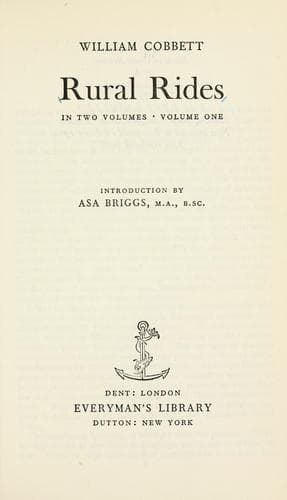
Great Britain -- Description and travel; Great Britain -- Rural conditions
In quitting Frant I descended into a country more woody than that behind
me. I asked a man whose fine woods those were that I pointed to, and I
fairly gave _a start_ when he said the Marquis Camden's. Milton talks of
the _Leviathan_ in a way to make one draw in one's shoulders with fear;
and I appeal to any one, who has been at sea when a whale has come near
the ship, whether he has not, at the first sight of the monster, made a
sort of involuntary movement, as if to _get out of the way_. Such was
the movement that I now made. However, soon coming to myself, on I
walked my horse by the side of my pedestrian informant. It is Bayham
Abbey that this great and awful sinecure placeman owns in this part of
the county. Another great estate he owns near Sevenoaks. But here alone
he spreads his length and breadth over more, they say, than ten or
twelve thousand acres of land, great part of which consists of
oak-woods. But, indeed, what estates might he not purchase? Not much
less than thirty years he held a place, a sinecure place, that yielded
him about thirty thousand pounds a-year! At any rate, he, according to
Parliamentary accounts, has received, of public money, little short of a
million of guineas. These, at 30 guineas an acre, would buy thirty
thousand acres of land. And what did he have all this money _for_?
Answer me that question, Wilberforce, you who called him a "bright
star," when he gave up _a part_ of his enormous sinecure. He gave up all
but the _trifling_ sum of nearly three thousand pounds a-year! What a
bright star! And _when_ did he give it up? When the _Radical_ had made
the country ring with it. When his name was, by their means, getting
into every mouth in the kingdom; when every Radical speech and petition
contained the name of Camden. Then it was, and not till then, that this
"bright star" let fall part of its "brilliancy." So that Wilberforce
ought to have thanked the _Radicals_, and not Camden. When he let go his
grasp, he talked of the merits of his father. His father was a lawyer,
who was exceedingly well paid for what he did without a million of money
being given to his son. But there is something rather out of
common-place to be observed about this father. This father was the
contemporary of Yorke, who became Lord Hardwicke. Pratt and Yorke, and
the merit of Pratt was that he was constantly opposed to the principles
of Yorke. Yorke was called a _Tory_ and Pratt a _Whig_; but the devil of
it was, both got to be Lords; and, in one shape or another, the families
of both have, from that day to this, been receiving great parcels of the
public money! Beautiful system! The Tories were for _rewarding Yorke_;
the Whigs were for _rewarding Pratt_. The Ministers (all in good time!)
humoured both parties; and the stupid people, divided into _tools of two
factions_, actually applauded, now one part of them, and now the other
part of them, the squandering away of their substance. They were like
Public-domain text, read in full here on John Shaqi.
Reviews
Reviews
No reviews yet
Be the first to share your thoughts on this work.
Elsewhere in the archive
Join the Discussion
Join the discussion
Sign in to leave a comment or review.
Sign InorCreate an account