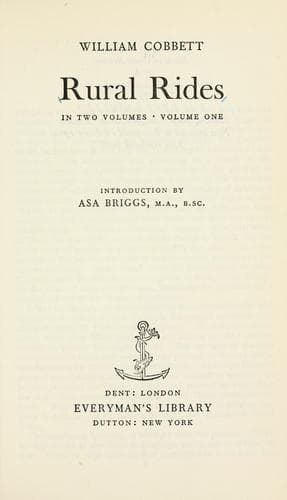
Great Britain -- Description and travel; Great Britain -- Rural conditions
here!" I always think of this, when I see a church full of pews; as,
indeed, is now always the case with our churches. Those who built these
churches had no idea of this: they made their calculations as to the
people to be contained in them, not making any allowance for _deal
boards_. I often wonder how it is that the present parsons are not
ashamed to call the churches _theirs_! They must know the origin of
them; and how they can look at them, and at the same time revile the
Catholics, is astonishing to me.
This evening I have been to the Methodist Meeting-house. I was
attracted, fairly drawn all down the street, by the _singing_. When I
came to the place the parson was got into prayer. His hands were
clenched together and held up, his face turned up and back so as to be
nearly parallel with the ceiling, and he was bawling away, with his "do
thou," and "mayest thou," and "may we," enough to stun one. Noisy,
however, as he was, he was unable to fix the attention of a parcel of
girls in the gallery, whose eyes were all over the place, while his eyes
were so devoutly shut up. After a deal of this rigmarole called prayer,
came the _preachy_, as the negroes call it; and a _preachy_ it really
was. Such a mixture of whining cant and of foppish affectation I
scarcely ever heard in my life. The text was (I speak from memory) one
of Saint Peter's epistles (if he have more than one) the 4th Chapter and
18th Verse. The words were to this amount: that, _as the righteous
would be saved with difficulty, what must become of the ungodly and the
sinner_! After as neat a dish of nonsense and of impertinences as one
could wish to have served up, came the distinction between the _ungodly_
and the _sinner_. The sinner was one who did moral wrong; the ungodly,
one who did no moral wrong, but who was not regenerated. _Both_, he
positively told us, were to be damned. One was just as bad as the other.
Moral rectitude was to do nothing in saving the man. He was to be damned
unless born again, and how was he to be born again unless he came to the
regeneration-shop and gave the fellows money? He distinctly told us that
a man perfectly moral might be damned; and that "the vilest of the vile
and the basest of the base" (I quote his very words) "would be saved if
they became regenerate; and that colliers, whose souls had been as black
as their coals, had by regeneration become bright as the saints that
sing before God and the Lamb." And will the _Edinburgh Reviewers_ again
find fault with me for cutting at this bawling, canting crew? Monstrous
it is to think that the Clergy of the Church really encourage these
roving fanatics. The Church seems aware of its loss of credit and of
power. It seems willing to lean even upon these men; who, be it
observed, seem, on their part, to have taken the Church under their
protection. They always pray for the _Ministry_; I mean the ministry at
_Whitehall_. They are most "loyal" souls. The THING _protects them_; and
Public-domain text, read in full here on John Shaqi.
Reviews
Reviews
No reviews yet
Be the first to share your thoughts on this work.
Elsewhere in the archive
Join the Discussion
Join the discussion
Sign in to leave a comment or review.
Sign InorCreate an account