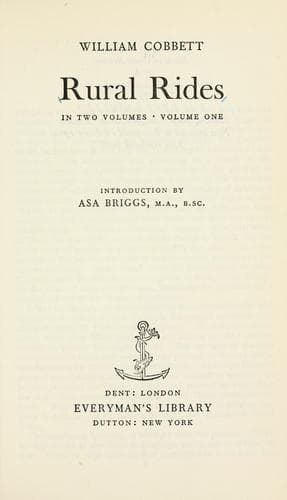
Great Britain -- Description and travel; Great Britain -- Rural conditions
I got to this place about half an hour after the ringing of the eight
o'clock bell, or Curfew, which I heard at about two miles' distance from
the place. From the town of Dover you come up the Castle-Hill, and have
a most beautiful view from the top of it. You have the sea, the chalk
cliffs of Calais, the high land at Boulogne, the town of Dover just
under you, the valley towards Folkestone, and the much more beautiful
valley towards Canterbury; and, going on a little further, you have the
Downs and the Essex or Suffolk coast in full view, with a most beautiful
corn country to ride along through. The corn was chiefly cut between
Dover and Walmer. The barley almost all cut and tied up in sheaf.
Nothing but the beans seemed to remain standing along here. They are not
quite so good as the rest of the corn; but they are by no means bad.
When I came to the village of Walmer, I enquired for the Castle; that
famous place, where Pitt, Dundas, Perceval, and all the whole tribe of
plotters against the French Revolution had carried on their plots. After
coming through the village of Walmer, you see the entrance of the Castle
away to the right. It is situated pretty nearly on the water's edge, and
at the bottom of a little dell, about a furlong or so from the
turnpike-road. This is now the habitation of our Great Minister, Robert
Bankes Jenkinson, son of Charles of that name. When I was told, by a
girl who was leasing in a field by the road side, that that was Walmer
Castle, I stopped short, pulled my horse round, looked steadfastly at
the gateway, and could not help exclaiming: "Oh, thou who inhabitest
that famous dwelling; thou, who hast always been in place, let who might
be out of place! Oh, thou everlasting placeman! thou sage of
'over-production,' do but cast thine eyes upon this barley-field, where,
if I am not greatly deceived, there are from seven to eight quarters
upon the acre! Oh, thou whose _Courier_ newspaper has just informed its
readers that wheat will be seventy shillings the quarter, in the month
of November: oh, thou wise man, I pray thee come forth, from thy Castle,
and tell me what thou wilt do if wheat should happen to be, at the
appointed time, thirty-five shillings, instead of seventy shillings, the
quarter. Sage of over-production, farewell. If thou hast life, thou wilt
be Minister, as long as thou canst pay the interest of the Debt in full,
but not one moment longer. The moment thou ceasest to be able to squeeze
from the Normans a sufficiency to count down to the Jews their full
tale, that moment, thou great stern-path-of-duty man, thou wilt begin to
be taught the true meaning of the words _Ministerial Responsibility_."
Public-domain text, read in full here on John Shaqi.
Reviews
Reviews
No reviews yet
Be the first to share your thoughts on this work.
Elsewhere in the archive
Join the Discussion
Join the discussion
Sign in to leave a comment or review.
Sign InorCreate an account