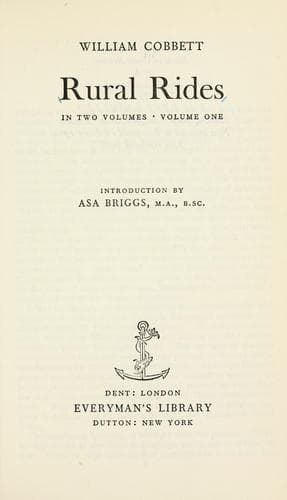
Great Britain -- Description and travel; Great Britain -- Rural conditions
that a number of people, boarded in the same house, and at the same
table, can, with as good food, be boarded much cheaper than those
persons divided into twos, threes, or fours, can be boarded. This is a
well-known truth: therefore, if the farmer now shuts his pantry against
his labourers, and pays them wholly in money, is it not clear, that he
does it because he thereby gives them a living _cheaper_ to him; that is
to say, a _worse_ living than formerly? Mind, he has _a house_ for them;
a kitchen for them to sit in, bed rooms for them to sleep in, tables,
and stools, and benches, of everlasting duration. All these he has: all
these _cost him nothing_; and yet so much does he gain by pinching them
in wages, that he lets all these things remain as of no use, rather than
feed labourers in the house. Judge, then, of the _change_ that has taken
place in the condition of these labourers! And be astonished, if you
can, at the _pauperism_ and the _crimes_ that now disgrace this once
happy and moral England.
The land produces, on an average, what it always produced; but there is
a new distribution of the produce. This 'Squire Charington's father
used, I dare say, to sit at the head of the oak-table along with his
men, say grace to them, and cut up the meat and the pudding. He might
take a cup of _strong beer_ to himself, when they had none; but that was
pretty nearly all the difference in their manner of living. So that
_all_ lived well. But the _'Squire_ had many _wine-decanters_ and
_wine-glasses_ and "a _dinner set_" and a "_breakfast set_," and
"_desert knives_:" and these evidently imply carryings on and a
consumption that must of necessity have greatly robbed the long oak
table if it had remained fully tenanted. That long table could not share
in the work of the decanters and the dinner set. Therefore, it became
almost untenanted; the labourers retreated to hovels, called cottages;
and, instead of board and lodging, they got money; so little of it as to
enable the employer to drink wine; but, then, that he might not reduce
them to _quite starvation_, they were enabled to come to him, in the
_king's name_, and demand food _as paupers_. And, now, mind, that which
a man receives in the _king's name_, he knows well he has _by force_;
and it is not in nature that he should _thank_ anybody for it, and least
of all the party _from whom it is forced_. Then, if this sort of force
be insufficient to obtain him enough to eat and to keep him warm, is it
surprising, if he think it no great offence against God (who created no
man to starve) to use another sort of FORCE more within his own control?
Is it, in short, surprising, if he resort to _theft_ and _robbery_?
Public-domain text, read in full here on John Shaqi.
Reviews
Reviews
No reviews yet
Be the first to share your thoughts on this work.
Elsewhere in the archive
Join the Discussion
Join the discussion
Sign in to leave a comment or review.
Sign InorCreate an account