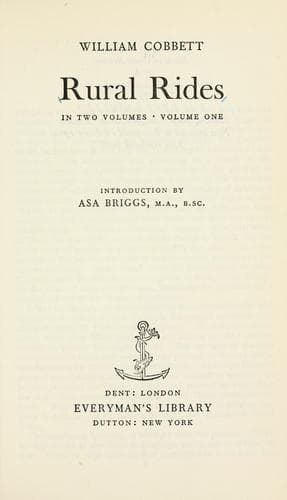
Great Britain -- Description and travel; Great Britain -- Rural conditions
Stop your protestations and hear my Reigate anecdote, which, as I said
above, brought the recollection of the Old Priory into my head. The
readers of the Register heard me, several times, some years ago, mention
Mr. Baron Maseres, who was, for a great many years, what they call
Cursitor Baron of the Exchequer. He lived partly in London and partly at
Reigate, for more, I believe, than half a century; and he died, about
two years ago, or less, leaving, I am told, _more than a quarter of a
million of money_. The Baron came to see me, in Pall Mall, in 1800. He
always came frequently to see me, wherever I was in London; not by any
means omitting to _come to see me in Newgate_, where I was imprisoned
for two years, with a thousand pounds fine and seven years heavy bail,
for having expressed my indignation at the flogging of Englishmen, in
the heart of England, under a guard of German bayonets; and to Newgate
he always came in _his wig and gown_, in order, as he said, to show his
abhorrence of the sentence. I several times passed a week, or more, with
the Baron at his house, at Reigate, and might have passed many more, if
my time and taste would have permitted me to accept of his invitations.
Therefore, I knew the Baron well. He was a most conscientious man; he
was when I first knew him, still a very clever man; he retained all his
faculties to a very great age; in 1815, I think it was, I got a letter
from him, written in a firm hand, correctly as to grammar, and ably as
to matter, and he must then have been little short of ninety. He never
was a bright man; but had always been a very sensible, just and humane
man, and a man too who always cared a great deal for the public good;
and he was the only man that I ever heard of, who refused to have his
salary augmented, when an augmentation was offered, and when all other
such salaries were augmented. I had heard of this: I asked him about it
when I saw him again; and he said: "There was no _work_ to be added, and
I saw no justice in adding to the salary. It must," added he, "be _paid
by somebody_, and the more I take, the less that somebody must have."
He did not save money for money's sake. He saved it because his habits
would not let him spend it. He kept a house in Rathbone Place, chambers
in the Temple, and his very pretty place at Reigate. He was by no means
stingy, but his scale and habits were cheap. Then, consider, too, a
bachelor of nearly a hundred years old. His father left him a fortune,
his brother (who also died a very old bachelor), left him another; and
the money lay in the funds, and it went on doubling itself over and over
again, till it became that immense mass which we have seen above, and
which, when the Baron was making his will, he had neither Catholic
priest nor Protestant parson to exhort him to leave to the church and
the poor, instead of his relations; though, as we shall presently see,
he had somebody else to whom to leave his great heap of money.
Public-domain text, read in full here on John Shaqi.
Reviews
Reviews
No reviews yet
Be the first to share your thoughts on this work.
Elsewhere in the archive
Join the Discussion
Join the discussion
Sign in to leave a comment or review.
Sign InorCreate an account