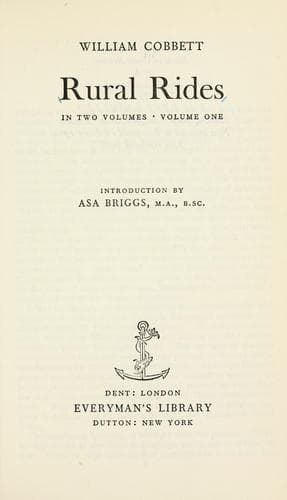
Great Britain -- Description and travel; Great Britain -- Rural conditions
Alas! poor Baron! he does not seem to have at all foreseen what was to
become of his own money! What would he have said to me, if I had
answered his observations by predicting, that _he_ would give his great
mass of money to a little parson for that parson's own private use;
leave only a mere pittance to his own relations; leave the little parson
his house in which we were then sitting (along with all his other real
property); that the little parson would come into the house and take
possession; and that his own relations (two nieces) would walk out! Yet,
all this has actually taken place, and that, too, after the poor old
Baron's four score years of jokes about the tricks of _Popish_ priests,
practised, in the _dark ages_, upon the _ignorant_ and _superstitious_
people of Reigate.
When I first knew the Baron he was a staunch _Church of England man_. He
went to church every Sunday once, at least. He used to take me to
Reigate church; and I observed, that he was very well versed in his
prayer book. But a decisive proof of his zeal as a Church of England man
is, that he settled an annual sum on the incumbent of Reigate, in order
to induce him to preach, or pray (I forget which), in the church, twice
on a Sunday, instead of once; and, in case this additional preaching, or
praying, were not performed in Reigate church, the annuity was to go
(and sometimes it does now go) to the poor of an adjoining parish, and
not to those of Reigate, lest I suppose, the parson, the overseers, and
other rate-payers, might happen to think that the Baron's annuity would
be better laid out in food for the bodies than for the souls of the
poor; or, in other words, lest the money should be taken annually and
added to the poor-rates to ease the purses of the farmers.
It did not, I dare say, occur to the poor Baron (when he was making
this settlement), that he was now giving money to make a church parson
put up additional prayers, though he had, all his lifetime, been
laughing at those, who, in the _dark_ ages, gave money, for this
purpose, to Catholic priests. Nor did it, I dare say, occur, to the
Baron, that, in his contingent settlement of the annuity on the poor of
an adjoining parish, he as good as declared his opinion, that he
distrusted the piety of the parson, the overseers, the churchwardens,
and, indeed, of all the people of Reigate: yes, at the very moment that
he was providing additional prayers for them, he in the very same
parchment, put a provision, which clearly showed that he was thoroughly
convinced that they, overseers, churchwardens, people, parson and all,
loved money better than prayers.
Public-domain text, read in full here on John Shaqi.
Reviews
Reviews
No reviews yet
Be the first to share your thoughts on this work.
Elsewhere in the archive
Join the Discussion
Join the discussion
Sign in to leave a comment or review.
Sign InorCreate an account