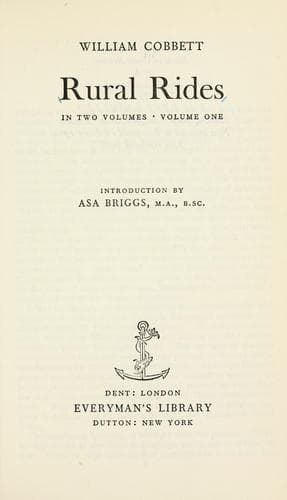
Great Britain -- Description and travel; Great Britain -- Rural conditions
As with the press, so is it with Mr. Brougham and all such politicians.
They stop short, or, rather, they begin in the middle. They attempt to
prevent the evils of the deadly ivy by cropping off, or, rather,
bruising a little, a few of its leaves. They do not assail even its
branches, while they appear to look upon the _trunk_ as something _too
sacred_ even to be _looked at_ with vulgar eyes. Is not the injury
recently done to about _forty thousand poor families_ in and near
Plymouth, by the Small-note Bill, a thing that Mr. Brougham ought to
think about before he thinks anything more about _educating_ those poor
families? Yet will he, when he again meets the Ministers, say a word
about this monstrous evil? I am afraid that no Member will say a word
about it; but I am rather more than afraid that _he_ will not. And
_why_? Because, if he reproach the Ministers with this crying cruelty,
they will ask him first how this is to be prevented without a repeal of
the Small-note Bill (by which Peel's Bill was partly repealed); then
they will ask him, how the prices are to be kept up without the
small-notes; then they will say, "Does the honourable and learned
Gentleman _wish to see wheat at four shillings a bushel again_?"
B. No (looking at Mr. Western and Daddy Coke), no, no, no! Upon my
honour, no!
MIN. Does the honourable and learned Gentleman wish to see Cobbett again
at county meetings, and to see petitions again coming from those
meetings, calling for a reduction of the interest of the...?
B. No, no, no, upon my soul, no!
MIN. Does the honourable and learned Gentleman wish to see that
"_equitable_ adjustment," which Cobbett has a thousand times declared
can never take place without an application, to new purposes, of that
great mass of public property, commonly called Church property?
B. (Almost bursting with rage). How _dare_ the honourable gentlemen to
suppose me capable of such a thought?
MIN. We suppose nothing. We only ask the question; and we ask it,
because to put an end to the small-notes would inevitably produce all
these things; and it is impossible to have small-notes to the extent
necessary to _keep up prices_, without having, now-and-then, _breaking
banks_. Banks cannot break without _producing misery_; you must have the
_consequence_ if you will have the _cause_. The honourable and learned
Gentleman wants the feast without the reckoning. In short, is the
honourable and learned Gentleman for putting an end to "_public
credit_"?
B. No, no, no, no!
MIN. Then would it not be better for the honourable and learned
Gentleman to _hold his tongue_?
Public-domain text, read in full here on John Shaqi.
Reviews
Reviews
No reviews yet
Be the first to share your thoughts on this work.
Elsewhere in the archive
Join the Discussion
Join the discussion
Sign in to leave a comment or review.
Sign InorCreate an account