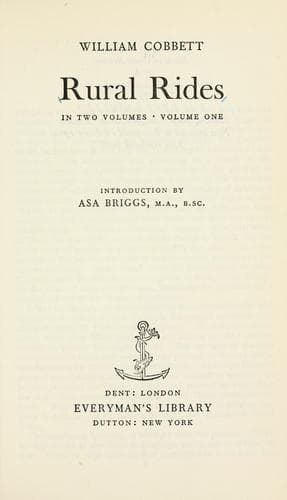
Great Britain -- Description and travel; Great Britain -- Rural conditions
Not so the product of the little sedgy rivulet of Whitchurch! It has, in
the short space of a hundred and thirty-one years, and, indeed, in the
space of the last _forty_, caused greater changes as to property than
had been caused by all other things put together in the long course of
seven centuries, though during that course there had been a sweeping,
confiscating Protestant reformation. Let us look back to the place where
I started on this present rural ride. Poor old Baron Maseres, succeeded
at Reigate by little Parson Fellowes, and at Betchworth (three miles on
my road) by Kendrick, is no bad instance to begin with; for the Baron
was nobly descended, though from French ancestors. At Albury, fifteen
miles on my road, Mr. Drummond (a banker) is in the seat of one of the
Howards, and close by he has bought the estate, just pulled down the
house, and blotted out the memory of the Godschalls. At Chilworth, two
miles further down the same vale, and close under St. Martha's Hill, Mr.
Tinkler, a powder-maker (succeeding Hill, another powder-maker, who had
been a breeches-maker at Hounslow), has got the old mansion and the
estate of the old Duchess of Marlborough, who frequently resided in what
was then a large quadrangular mansion, but the remains of which now
serve as out farm-buildings and a farmhouse, which I found inhabited by
a poor labourer and his family, the farm being in the hands of the
powder-maker, who does not find the once noble seat good enough for him.
Coming on to Waverley Abbey, there is Mr. Thompson, a merchant,
succeeding the Orby Hunters and Sir Robert Rich. Close adjoining, Mr.
Laing, a West India dealer of some sort, has stepped into the place of
the lineal descendants of Sir William Temple. At Farnham the park and
palace remain in the hands of a Bishop of Winchester, as they have done
for about eight hundred years: but why is this? Because they are public
property; because they cannot, without express laws, be transferred.
Therefore the product of the rivulet of Whitchurch has had no effect
upon the ownership of these, which are still in the hands of a Bishop of
Winchester; not of a William of Wykham, to be sure; but still, in those
of a bishop, at any rate. Coming on to old Alresford (twenty miles from
Farnham) Sheriff, the son of a Sheriff, who was a Commissary in the
American war, has succeeded the Gages. Two miles further on, at
Abbotston (down on the side of the Itchen) Alexander Baring has
succeeded the heirs and successors of the Duke of Bolton, the remains of
whose noble mansion I once saw here. Not above a mile higher up, the
same Baring has, at the Grange, with its noble mansion, park and estate,
succeeded the heirs of Lord Northington; and at only about two miles
further, Sir Thomas Baring, at Stratton Park, has succeeded the Russells
in the ownership of the estates of Stratton and Micheldover, which were
once the property of Alfred the Great! Stepping back, and following my
Public-domain text, read in full here on John Shaqi.
Reviews
Reviews
No reviews yet
Be the first to share your thoughts on this work.
Elsewhere in the archive
Join the Discussion
Join the discussion
Sign in to leave a comment or review.
Sign InorCreate an account