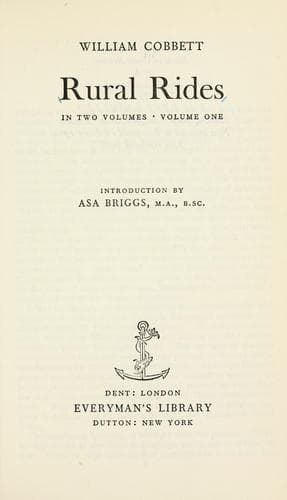
Great Britain -- Description and travel; Great Britain -- Rural conditions
felons in the gaols; but never, no never, do we catch them ejaculating
one single pious sigh for these innumerable sufferers, who are doomed to
become felons or to waste away their bodies by hunger.
When we came into the village of Rogate, I saw a little group of persons
standing before a blacksmith's shop. The church-yard was on the other
side of the road, surrounded by a low wall. The earth of the church-yard
was about four feet and a half higher than the common level of the
ground round about it; and you may see, by the nearness of the church
windows to the ground, that this bed of earth has been made by the
innumerable burials that have taken place in it. The group, consisting
of the blacksmith, the wheelwright, perhaps, and three or four others,
appeared to me to be in a deliberative mood. So I said, looking
significantly at the church-yard, "It has taken a pretty many thousands
of your fore-fathers to raise that ground up so high." "Yes, Sir," said
one of them. "And," said I, "for about nine hundred years those who
built that church thought about religion very differently from what we
do." "Yes," said another. "And," said I, "do you think that all those
who made that heap there are gone to the devil?" I got no answer to
this. "At any rate," added I, "they never worked for a pound and a half
of bread a day." They looked hard at me, and then looked hard at one
another; and I, having trotted off, looked round at the first turning,
and saw them looking after us still. I should suppose that the church
was built about seven or eight hundred years ago, that is to say, the
present church; for the first church built upon this spot was, I dare
say, erected more than a thousand years ago. If I had had time, I should
have told this group that, before the Protestant Reformation, the
labourers of Rogate received four-pence a day from Michaelmas to
Lady-day; five-pence a day from Lady-day to Michaelmas, except in
harvest and grass-mowing time, when able labourers had seven-pence a
day; and that, at this time, bacon was _not so much as a halfpenny a
pound_: and, moreover, that the parson of the parish maintained out of
the tithes all those persons in the parish that were reduced to
indigence by means of old age or other cause of inability to labour. I
should have told them this, and, in all probability a great deal more,
but I had not time; and, besides, they will have an opportunity of
reading all about it in my little book called the _History of the
Protestant Reformation_.
Public-domain text, read in full here on John Shaqi.
Reviews
Reviews
No reviews yet
Be the first to share your thoughts on this work.
Elsewhere in the archive
Join the Discussion
Join the discussion
Sign in to leave a comment or review.
Sign InorCreate an account