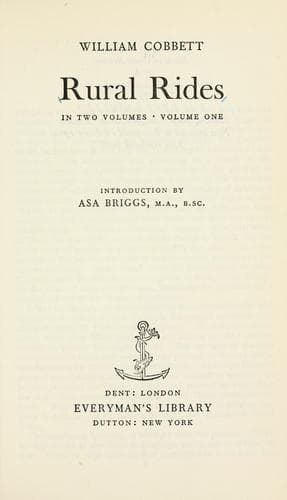
Great Britain -- Description and travel; Great Britain -- Rural conditions
If such be the profit of planting ash, what would be the profit of
planting locust, even for poles or stakes? The locust would outgrow the
ash, as we have seen in the case of Mr. Gunter's plantation, more than
three to one. I am satisfied that it will do this upon any soil, if you
give the trees fifteen years to grow in; and, in short, that the locusts
will be trees when the ash are merely poles, if both are left to grow up
in single stems. If in coppice, the locust will make as good poles; I
mean as large and as long poles in six years, as the ash will in ten
years: to say nothing of the superior durability of the locust. I have
seen locusts, at Mr. Knowles's, at Thursley, sufficient for a hop-pole,
for an ordinary hop-pole, with only five years' growth in them, and
leaving the last year's growth to be cut off, leaving the top of the
pole three-quarters of an inch through. There is nothing that we have
ever heard of, of the timber kind, equal to this in point of quickness
of growth. In parts of the county where hop-poles are not wanted,
espalier stakes, wood for small fencing, hedge stakes, hurdle stakes,
fold-shores, as the people call them, are always wanted; and is it not
better to have a thing that will last twenty years, than a thing that
will last only three? I know of no English underwood which gives a hedge
stake to last even _two years_. I should think that a very profitable
way of employing the locust would be this. Plant a coppice, the plants
two feet apart. Thus planted, the trees will protect one another against
the wind. Keep the side shoots pruned off. At the end of six years, the
coppice, if well planted and managed, will be, at the very least, twenty
feet high to the tips of the trees. Not if the grass and weeds are
suffered to grow up to draw all the moisture up out of the ground, to
keep the air from the young plants, and to intercept the gentle rains
and the dews; but trenched ground, planted carefully, and kept clean;
and always bearing in mind that hares and rabbits and young locust trees
will never live together; for the hares and rabbits will not only bite
them off, but will gnaw them down to the ground, and, when they have
done that, will scratch away the ground to gnaw into the very root. A
gentleman bought some locust trees of me last year, and brought me a
dismal account in the summer of their being all dead; but I have since
found that they were all eaten up by the hares. He saw some of my
refuse; some of those which were too bad to send to him, which were a
great deal higher than his head. His ground was as good as mine,
according to his account; but I had no hares to fight against; or else
mine would have been all dead too.
Public-domain text, read in full here on John Shaqi.
Reviews
Reviews
No reviews yet
Be the first to share your thoughts on this work.
Elsewhere in the archive
Join the Discussion
Join the discussion
Sign in to leave a comment or review.
Sign InorCreate an account