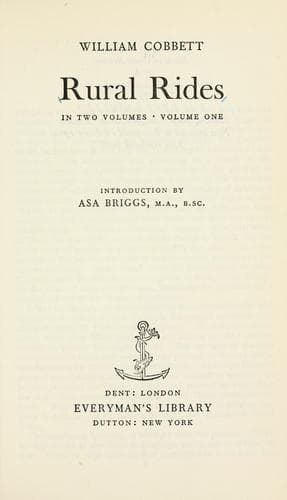
Great Britain -- Description and travel; Great Britain -- Rural conditions
This is, too, the notion of Burdett as expressed in his silly and most
nasty, musty aristocratic speech of last session. What, then, is to be
done with this _over-produce_? Who is to have it? Is it to go to
pensioners, placemen, tax-gatherers, dead-weight people, soldiers,
gendarmerie, police-people, and, in short, to whole millions _who do no
work at all_? Is this a cause of "national wealth"? Is a nation made
_rich_ by taking the food and clothing from those who create them, and
giving them to those who do nothing of any use? Aye, but this
over-produce may be given to _manufacturers_, and to those who supply
the food-raisers with what they want besides food. Oh! but this is
merely an _exchange_ of one valuable thing for another valuable thing;
it is an exchange of labour in Wiltshire for labour in Lancashire; and,
upon the whole, here is no _over-production_. If the produce be
exported, it is the same thing: it is an exchange of one sort of labour
for another. But _our course_ is, that there is not an exchange; that
those who labour, no matter in what way, have a large part of the fruit
of their labour taken away, and receive nothing in exchange. If the
over-produce of this Valley of Avon were given, by the farmers, to the
weavers in Lancashire, to the iron and steel chaps of Warwickshire, and
to other makers or sellers of useful things, there would come an
abundance of all these useful things into this valley from Lancashire
and other parts: but if, as is the case, the over-produce goes to the
fund-holders, the dead-weight, the soldiers, the lord and lady and
master and miss pensioners and sinecure people; if the over-produce go
to them, as a very great part of it does, nothing, not even the parings
of one's nails, can come back to the valley in exchange. And, can this
operation, then, add to the "national wealth"? It adds to the "wealth"
of those who carry on the affairs of state; it fills their pockets,
those of their relatives and dependents; it fattens all tax-eaters; but
it can give no wealth to the "nation," which means the whole of the
people. National Wealth means the Commonwealth or Commonweal; and these
mean, the general good, or happiness, of the people, and the safety and
honour of the state; and these are not to be secured by robbing those
who labour, in order to support a large part of the community in
idleness. Devizes is the market-town to which the corn goes from the
greater part of this Valley. If, when a wagon-load of wheat goes off in
the morning, the wagon came back at night loaded with cloth, salt, or
something or other, equal in value to the wheat, except what might be
necessary to leave with the shopkeeper as his profit; then, indeed, the
people might see the wagon go off without tears in their eyes. But now
they see it go to carry away, and to bring next to nothing in return.
Public-domain text, read in full here on John Shaqi.
Reviews
Reviews
No reviews yet
Be the first to share your thoughts on this work.
Elsewhere in the archive
Join the Discussion
Join the discussion
Sign in to leave a comment or review.
Sign InorCreate an account