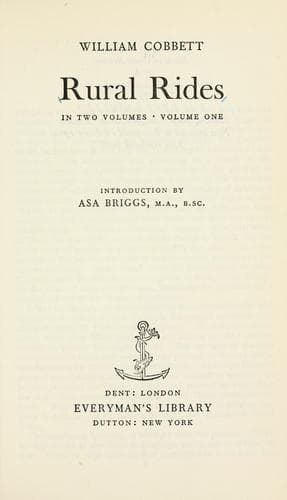
Great Britain -- Description and travel; Great Britain -- Rural conditions
We immediately, alter this, crossed the road, and went on towards
Crondall upon a soil that soon became stiff loam and flint at top with a
bed of chalk beneath. We did not go to Crondall; but kept along over
Slade Heath, and through a very pretty place called Well. We arrived at
Odiham about half after eleven, at the end of a beautiful ride of about
seventeen miles, in a very fine and pleasant day.
_Winchester, Saturday, 28th September._
Just after daylight we started for this place. By the turnpike we could
have come through Basingstoke by turning off to the right, or through
Alton and Alresford by turning off to the left. Being naturally disposed
towards a middle course, we chose to wind down through Upton-Gray,
Preston-Candover, Chilton-Candover, Brown-Candover, then down to
Ovington, and into Winchester by the north entrance. From Wrecklesham to
Winchester we have come over roads and lanes of flint and chalk. The
weather being dry again, the ground under you, as solid as iron, makes a
great rattling with the horses' feet. The country where the soil is
stiff loam upon chalk is never bad for corn. Not rich, but never poor.
There is at no time anything deserving to be called dirt in the roads.
The buildings last a long time, from the absence of fogs and also the
absence of humidity in the ground. The absence of dirt makes the people
habitually cleanly; and all along through this country the people appear
in general to be very neat. It is a country for sheep, which are always
sound and good upon this iron soil. The trees grow well, where there are
trees. The woods and coppices are not numerous; but they are good,
particularly the ash, which always grows well upon the chalk. The oaks,
though they do not grow in the spiral form, as upon the clays, are by no
means stunted; and some of them very fine trees; I take it that they
require a much greater number of years to bring them to perfection than
in the _Wealds_. The wood, perhaps, may be harder; but I have heard that
the oak, which grows upon these hard bottoms, is very frequently what
the carpenters call _shaky_. The underwoods here consist, almost
entirely, of hazle, which is very fine, and much tougher and more
durable than that which grows on soils with a moist bottom. This hazle
is a thing of great utility here. It furnishes rods wherewith to make
fences; but its principal use is, to make _wattles_ for the folding of
sheep in the fields. These things are made much more neatly here than in
the south of Hampshire and in Sussex, or in any other part that I have
seen. Chalk is the favourite soil of the _yew-tree_; and at
Preston-Candover there is an avenue of yew-trees, probably a mile long,
each tree containing, as nearly as I can guess, from twelve to twenty
feet of timber, which, as the reader knows, implies a tree of
considerable size. They have probably been a century or two in growing;
but, in any way that timber can be used, the timber of the yew will
Public-domain text, read in full here on John Shaqi.
Reviews
Reviews
No reviews yet
Be the first to share your thoughts on this work.
Elsewhere in the archive
Join the Discussion
Join the discussion
Sign in to leave a comment or review.
Sign InorCreate an account