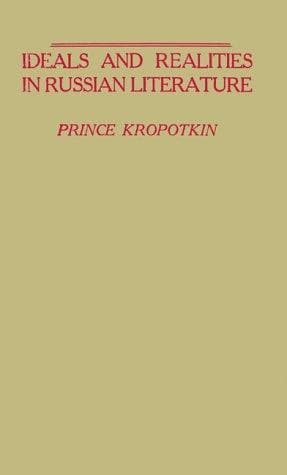
Russian literatureKropotkin, Petr Alekseevich, kniaz
History
Russian literature
Kropotkin, Petr Alekseevich, kniaz
Russian literature -- 19th century -- History and criticism
Few writers have established their reputation so rapidly as MAXÍM
GÓRKIY. His first sketches (1892-95) were published in an obscure
provincial paper of the Caucasus, and were totally unknown to the
literary world, but when a short tale of his appeared in a widely-read
review, edited by Korolénko, it at once attracted general attention.
The beauty of its form, its artistic finish, and the new note of
strength and courage which rang through it, brought the young writer
immediately into prominence. It became known that “Maxím Górkiy” was
the pseudonym of a quiet young man, A. PYÉSHKOFF, who was born in 1868
in Níjniy Nóvgorod, a large town on the Vólga; that his father was a
merchant or an artisan, his mother a remarkable peasant woman, who
died soon after the birth of her son, and that the boy, orphaned when
only nine, was brought up in a family of his father’s relatives. The
childhood of “Górkiy” must have been anything but happy, for one day he
ran away and entered into service on a Vólga river steamer. This took
place when he was only twelve. Later on he worked as a baker, became
a street porter, sold apples in a street, till at last he obtained
the position of clerk at a lawyer’s. In 1891 he lived and wandered on
foot with the tramps in South Russia, and during these wanderings he
wrote a number of short stories, of which the first was published in
1892, in a newspaper of Northern Caucasia. The stories proved to be
remarkably fine, and when a collection of all that he had hitherto
written was published in 1900, in four small volumes, the whole of a
large edition was sold in a very short time, and the name of Górkiy
took its place--to speak of living novelists only--by the side of those
of Korolénko and Tchéhoff, immediately after the name of Leo Tolstóy.
In Western Europe and America his reputation was made with the same
rapidity as soon as a couple of his sketches were translated into
French and German, and re-translated into English.
Public-domain text, read in full here on John Shaqi.
Reviews
Reviews
No reviews yet
Be the first to share your thoughts on this work.
Elsewhere in the archive
Join the Discussion
Join the discussion
Sign in to leave a comment or review.
Sign InorCreate an account