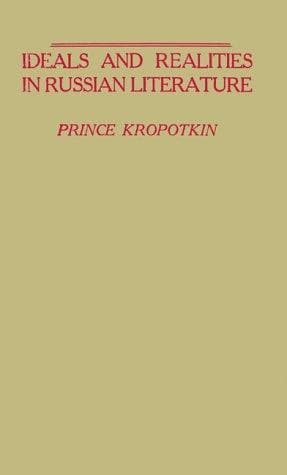
Russian literatureKropotkin, Petr Alekseevich, kniaz
History
Russian literature
Kropotkin, Petr Alekseevich, kniaz
Russian literature -- 19th century -- History and criticism
The arsenal of punishments is thus pretty large; but there is still
something else. It is the system of ministerial circulars. Suppose a
strike takes place, or some scandalous bribery has been discovered in
some branch of the administration. Immediately all papers and reviews
receive a circular from the Ministry of the Interior prohibiting them
to speak of that strike, or that scandal. Even less important matters
will be tabooed in this way. Thus a few years ago an anti-Semitic
comedy was put on the stage at St. Petersburg. It was imbued with the
worst spirit of national hatred towards the Jews, and the actress who
was given the main part in it refused to play. She preferred to break
her agreement with the manager rather than to play in that comedy.
Another actress was engaged. This became known to the public, and at
the first representation a formidable demonstration was made against
the actors who had accepted parts in the play, and also against the
author. Some eighty arrests--chiefly of students and other young
people and of litterateurs--were made from among the audience, and
for two days the St. Petersburg papers were full of discussions of
the incident; but then came the ministerial circular prohibiting any
further reference to the subject, and on the third day there was not a
word said about the matter in all the Press of Russia.
Socialism, the social question altogether, and the labour movement are
continually tabooed by ministerial circulars--to say nothing of Society
and Court scandals, or of the thefts which may be discovered from
time to time in the higher administration. At the end of the reign of
Alexander II. the theories of Darwin, Spencer, and Buckle were tabooed
in the same way, and their works were prevented from being kept by the
circulating libraries.
This is what censorship means nowadays. As to what was formerly, a very
amusing book could be made of the antics of the different censors,
simply by utilising Skabitchévskiy’s _History of Censorship_. Suffice
it to say that when Púshkin, speaking of a lady, wrote: “Your divine
features,” or mentioned “her celestial beauty,” the censorship would
cross out these verses and write, in red ink on the MS., that such
expressions were offensive to divinity and could not be allowed. Verses
were mutilated without any regard to the rules of versification; and
very often the censor introduced, in a novel, scenes of his own.
Public-domain text, read in full here on John Shaqi.
Reviews
Reviews
No reviews yet
Be the first to share your thoughts on this work.
Elsewhere in the archive
Join the Discussion
Join the discussion
Sign in to leave a comment or review.
Sign InorCreate an account