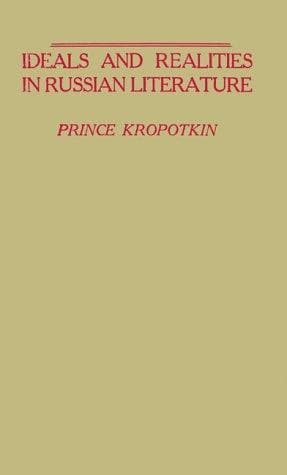
Russian literatureKropotkin, Petr Alekseevich, kniaz
History
Russian literature
Kropotkin, Petr Alekseevich, kniaz
Russian literature -- 19th century -- History and criticism
It does not enter into the plan of this book to analyse contemporary
Russian writers. Another volume would be required to do them justice,
not only on account of the literary importance of some of them, and
the interest of the various directions in Art which they represent,
but especially because in order to properly explain the character of
the present literature, and the different currents in Russian Art, it
would be necessary to enter into many details concerning the unsettled
conditions under which the country has been living during the last
thirty years. Moreover, most of the contemporary writers have not yet
said their last word, and we can expect from them works of even greater
value than any they have hitherto produced. I am compelled, therefore,
to limit myself to brief remarks concerning the most prominent living
novelists of the present day.
OERTEL (born 1855) has unfortunately abandoned literature during the
last few years, just at a time when his last novel, _Smyéna_ (_Changing
Guards_), had given proofs of a further development of his sympathetic
talent. He was born in the borderland of the Russian Steppes, and was
brought up on one of the large estates of this region. Later on he
went to the university of St. Petersburg and, as a matter of fact,
was compelled to leave it after some “students’ disorders,” and was
interned in the town of Tver. He soon returned, however, to his native
Steppe region, which he cherishes with the same love as Nikítin and
Koltsóff.
Oertel began his literary career by short sketches which are now
collected in two volumes under the name of _Notebook of a Prairie-Man_,
and whose manner suggests Turguéneff’s _Sportsman’s Notebook_. The
nature of the prairies is admirably described in these little stories,
with great warmth and poetry, and the types of peasants who appear
in the stories are perfectly true to nature, without any attempts at
idealisation, although one feels that the author is no great admirer
of the “intellectuals” and fully appreciates the general ethics of
rural life. Some of these sketches, especially those which deal with
the growing _bourgeoisie du village_, are highly artistic. _Two
Couples_ (1887), in which the parallel stories of two young couples in
love--one of educated people and the other of peasants--are given, is
a story evidently written under the influence of the ideas of Tolstóy,
and bearing traces of a preconceived idea, which spoils in places the
artistic value of the novel. There are nevertheless admirable scenes,
testifying to very fine powers of observation.
Public-domain text, read in full here on John Shaqi.
Reviews
Reviews
No reviews yet
Be the first to share your thoughts on this work.
Elsewhere in the archive
Join the Discussion
Join the discussion
Sign in to leave a comment or review.
Sign InorCreate an account