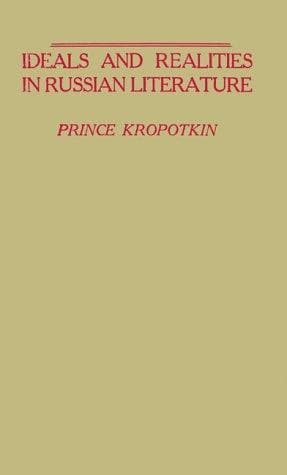
Russian literatureKropotkin, Petr Alekseevich, kniaz
History
Russian literature
Kropotkin, Petr Alekseevich, kniaz
Russian literature -- 19th century -- History and criticism
Tchéhoff’s heroes are not people who have never heard better words, or
never conceived better ideas than those which circulate in the lowest
circles of the Philistines. No, they have heard such words, and their
hearts have beaten once upon a time at the sound of such words. But the
common-place everyday life has stifled all such aspirations, apathy
has taken its place, and now there remains only a haphazard existence
amidst a hopeless meanness. The meanness which Tchéhoff represents is
the one which begins with the loss of faith in one’s forces and the
gradual loss of all those brighter hopes and illusions which make the
charm of all activity, and, then, step by step, this meanness destroys
the very springs of life: broken hopes, broken hearts, broken energies.
Man reaches a stage when he can only mechanically repeat certain
actions from day to day, and goes to bed, happy if he has “killed” his
time in any way, gradually falling into a complete intellectual apathy,
and a moral indifference. The worst is that the very multiplicity of
samples which Tchéhoff gives, without repeating himself, from so many
different layers of society, seems to tell the reader that it is the
rottenness of a whole civilisation, of an epoch, which the author
divulges to us.
Speaking of Tchéhoff, Tolstóy made the deep remark that he was one
of those few whose novels are willingly re-read more than once.
This is quite true. Every one of Tchéhoff’s stories--it may be the
smallest bagatelle or a small novel, or it may be a drama--produces
an impression which cannot easily be forgotten. At the same time they
contain such a profusion of minute detail, admirably chosen so as to
increase the impression, that in re-reading them one always finds a new
pleasure. Tchéhoff was certainly a great artist. Besides, the variety
of the men and women of all classes which appear in his stories,
and the variety of psychological subjects dealt in them, is simply
astounding. And yet every story bears so much the stamp of the author
that in the most insignificant of them you recognise Tchéhoff, with his
proper individuality and manner, with his conception of men and things.
Public-domain text, read in full here on John Shaqi.
Reviews
Reviews
No reviews yet
Be the first to share your thoughts on this work.
Elsewhere in the archive
Join the Discussion
Join the discussion
Sign in to leave a comment or review.
Sign InorCreate an account