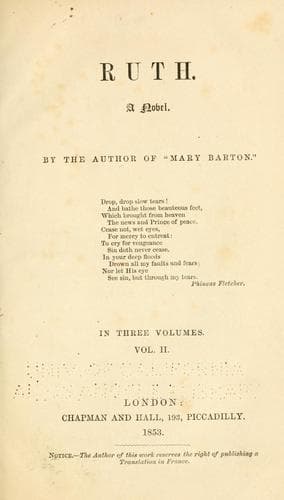
Domestic fiction; England -- Fiction; Mothers and sons -- Fiction; Religious fiction; Unmarried mothers -- Fiction
The chapel was up a narrow street, or rather _cul-de-sac_, close by.
It stood on the outskirts of the town, almost in fields. It was built
about the time of Matthew and Philip Henry, when the Dissenters were
afraid of attracting attention or observation, and hid their places
of worship in obscure and out-of-the-way parts of the towns in which
they were built. Accordingly, it often happened, as in the present
case, that the buildings immediately surrounding, as well as the
chapels themselves, looked as if they carried you back to a period
a hundred and fifty years ago. The chapel had a picturesque and
old-world look, for luckily the congregation had been too poor
to rebuild it, or new-face it, in George the Third's time. The
staircases which led to the galleries were outside, at each end of
the building, and the irregular roof and worn stone steps looked
grey and stained by time and weather. The grassy hillocks, each with
a little upright headstone, were shaded by a grand old wych-elm.
A lilac-bush or two, a white rose-tree, and a few laburnums, all
old and gnarled enough, were planted round the chapel yard; and
the casement windows of the chapel were made of heavy-leaded,
diamond-shaped panes, almost covered with ivy, producing a green
gloom, not without its solemnity, within. This ivy was the home of an
infinite number of little birds, which twittered and warbled, till
it might have been thought that they were emulous of the power of
praise possessed by the human creatures within, with such earnest,
long-drawn strains did this crowd of winged songsters rejoice and be
glad in their beautiful gift of life. The interior of the building
was plain and simple as plain and simple could be. When it was fitted
up, oak-timber was much cheaper than it is now, so the wood-work was
all of that description; but roughly hewed, for the early builders
had not much wealth to spare. The walls were whitewashed, and were
recipients of the shadows of the beauty without; on their "white
plains" the tracery of the ivy might be seen, now still, now stirred
by the sudden flight of some little bird. The congregation consisted
of here and there a farmer with his labourers, who came down from the
uplands beyond the town to worship where their fathers worshipped,
and who loved the place because they knew how much those fathers had
suffered for it, although they never troubled themselves with the
reason why they left the parish church; of a few shopkeepers, far
more thoughtful and reasoning, who were Dissenters from conviction,
unmixed with old ancestral association; and of one or two families of
still higher worldly station. With many poor, who were drawn there by
love for Mr Benson's character, and by a feeling that the faith which
made him what he was could not be far wrong, for the base of the
pyramid, and with Mr Bradshaw for its apex, the congregation stood
complete.
Public-domain text, read in full here on John Shaqi.
Reviews
Reviews
No reviews yet
Be the first to share your thoughts on this work.
Elsewhere in the archive
Join the Discussion
Join the discussion
Sign in to leave a comment or review.
Sign InorCreate an account