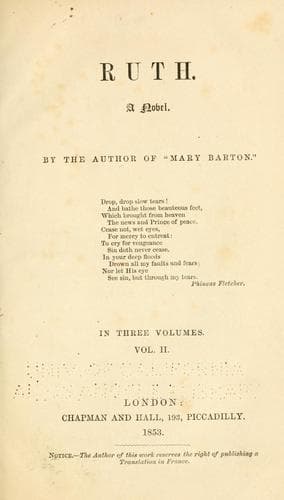
Domestic fiction; England -- Fiction; Mothers and sons -- Fiction; Religious fiction; Unmarried mothers -- Fiction
The jealous dislike which Jemima was allowing to grow up in her heart
against Ruth was, as she thought, never shown in word or deed. She
was cold in manner, because she could not be hypocritical; but her
words were polite and kind in purport; and she took pains to make
her actions the same as formerly. But rule and line may measure out
the figure of a man; it is the soul that gives it life; and there
was no soul, no inner meaning, breathing out in Jemima's actions.
Ruth felt the change acutely. She suffered from it some time before
she ventured to ask what had occasioned it. But, one day, she took
Miss Bradshaw by surprise, when they were alone together for a few
minutes, by asking her if she had vexed her in any way, she was so
changed? It is sad when friendship has cooled so far as to render
such a question necessary. Jemima went rather paler than usual, and
then made answer:
"Changed! How do you mean? How am I changed? What do I say or do
different from what I used to do?"
But the tone was so constrained and cold, that Ruth's heart sank
within her. She knew now, as well as words could have told her, that
not only had the old feeling of love passed away from Jemima, but
that it had gone unregretted, and no attempt had been made to recall
it. Love was very precious to Ruth now, as of old time. It was one of
the faults of her nature to be ready to make any sacrifices for those
who loved her, and to value affection almost above its price. She
had yet to learn the lesson, that it is more blessed to love than
to be beloved; and lonely as the impressible years of her youth had
been--without parents, without brother or sister--it was, perhaps,
no wonder that she clung tenaciously to every symptom of regard, and
could not relinquish the love of any one without a pang.
The doctor who was called in to Elizabeth prescribed sea-air as the
best means of recruiting her strength. Mr Bradshaw, who liked to
spend money ostentatiously, went down straight to Abermouth, and
engaged a house for the remainder of the autumn; for, as he told
the medical man, money was no object to him in comparison with his
children's health; and the doctor cared too little about the mode in
which his remedy was administered, to tell Mr Bradshaw that lodgings
would have done as well, or better, than the complete house he had
seen fit to take. For it was now necessary to engage servants, and
take much trouble, which might have been obviated, and Elizabeth's
removal effected more quietly and speedily, if she had gone into
lodgings. As it was, she was weary of hearing all the planning and
talking, and deciding and un-deciding, and re-deciding, before it was
possible for her to go. Her only comfort was in the thought that dear
Mrs Denbigh was to go with her.
Public-domain text, read in full here on John Shaqi.
Reviews
Reviews
No reviews yet
Be the first to share your thoughts on this work.
Elsewhere in the archive
Join the Discussion
Join the discussion
Sign in to leave a comment or review.
Sign InorCreate an account