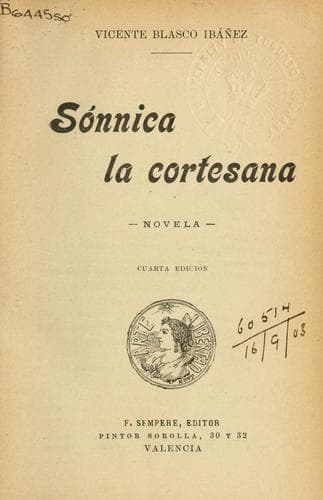
Sagunto (Spain) -- History -- Siege, 219-218 B.C. -- Fiction
A group of slave women chosen for their beauty, with Rhanto in the
premier rank, carried on their heads great amphoræ filled with honey and
water for the libations in honor of the goddess. Behind them marched the
musicians and singers of the city, crowned with roses, clad in flowing
white vestments. They swept the lyre, and played the flutes, and some
Greeks from Sónnica's pottery, who had been wandering rhapsodists, sang
fragments from the epic of the Trojan war before the barbarian throngs,
who scarcely understood them, but admired the harmonious cadence of
Homer's verses.
The people pressed forward, craning their necks to get a better view of
the salii, the dancing devotees of Mars, who advanced nude, armed with
sword and shield. Slung from the stick laid across their shoulders, two
slaves were carrying a row of bronze shields, on which another slave was
beating with a mallet, and keeping time to these harsh sounds the salii
danced, making feigned attacks, and raining blows with their swords on
the shield of the pretended adversary, uttering ferocious shouts, and
also performing pantomimes to recall the main episodes in the life of
the goddess Minerva.
Behind the clamor, which set the streets in a commotion, causing the
populace to roar with enthusiasm excited by the warlike display, came a
group of girls holding a peplus of finest texture on which the principal
Grecian women of the city had embroidered the combat of Minerva with the
Titans. It was the offering which was to remain in the new temple of the
goddess as a perpetual token of the festival.
Closing the procession, the sacred squadron advanced, the richest
citizens, mounted on fiery horses, which, with their evolutions
compelled the crowd to fall back against the walls. They presented a
brave display, making their steeds rear on their hind feet, guided only
by the bridle, riding bareback, pressing their knees into the horses'
ribs. The eldest of the horsemen wore huge hats in the Athenian fashion.
The young men wore the winged helmet of Mercury or went bareheaded,
their short curls bound by a fire-colored ribbon. Alorcus wore the crown
he had won, and Actæon, riding beside him on one of the Celtiberian's
horses, smiled at the crowd, which regarded him with a certain respect
as if he were Sónnica's husband and in possession of her enormous
riches. The horsemen gazed with pride at the swords which hung at their
sides and clanked against the flanks of their horses, and they took in
with a glance the high Acropolis and the city lying at its feet, as if
expressing confidence in their strength, and faith in the tranquility in
which Saguntum might dwell, sure of protection.
Public-domain text, read in full here on John Shaqi.
Reviews
Reviews
No reviews yet
Be the first to share your thoughts on this work.
Elsewhere in the archive
Join the Discussion
Join the discussion
Sign in to leave a comment or review.
Sign InorCreate an account