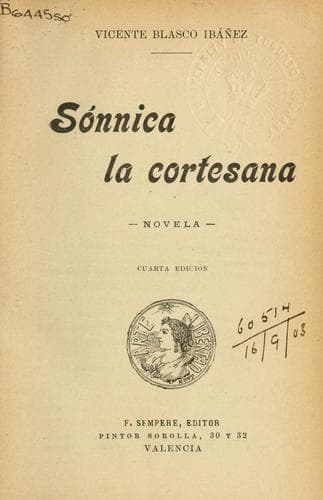
Sagunto (Spain) -- History -- Siege, 219-218 B.C. -- Fiction
The strong men bathed in horse urine to harden their muscles. Their only
luxury consisted in weapons. They admired as priceless jewels the bronze
swords brought from the north of the Peninsula, and those of steel made
by the people of Bilbilis and tempered in the sands of their famous
river. The flexible cuirasses, formed by several thicknesses of
superposed linen, or those of leather, decorated with nails, were
defensive arms which the Celtiberian never laid aside, not even when in
bed. They slept dressed in the sagum, the metal greaves on their legs,
and their weapons within reach of the hand, ready to fight the instant
the slightest alarm might disturb their sleep.
After three days of travel the caravan entered the territory belonging
to the tribes of Alorcus. The mountains separated on both sides of the
Jalón, forming smiling valleys covered by tall grasses, through which
ran herds of wild horses with curling manes and waving tails. The women
came out of the villages to greet Alorcus, and the men, grasping lances,
mounted their horses and joined the caravan. In the first village where
they stopped an old man told Alorcus that his father, the powerful
Endovellicus, was dying, and in the next through which they passed in a
few hours, he heard that the great chieftain had died at daybreak.
All the warriors of the tribe, herders and farmers, followed them on
horseback. When they reached the village where the kinglet had lived,
the escort had grown to a small army.
In the doorway of the paternal house, a low structure of red stones
roofed with logs, Alorcus saw his sisters in dresses made of flowers and
wearing around their necks and over their heads cage-like collars from
the bars of which hung mourning veils.
The sisters of Alorcus, as well as the women who accompanied them, the
wives of the chief warriors of the tribe, hid their grief at the death
of the chieftain, and smiled as if it were the eve of a festival. Old
age was a disgrace among the Celtiberians, who held life in contempt,
and fought for diversion when not engaged in war. To die in bed was
deemed dishonorable, and the only thing which somewhat disturbed the
serenity of the family of Endovellicus was that so famous a warrior, the
terror of neighboring clans, should have died with white hair, his life
flickering out like a wasted torch, after having galloped his steed
through so many combats, hurling his sword like a thunderbolt upon the
enemy.
Actæon's dress and his countenance attracted the curious gaze of all the
tribe. Many of the Celtiberians had never seen a Greek, and they looked
upon this one with hostile eyes, recalling the clever tricks and sharp
dealings of the Hellenic merchants experienced by their brethren when
they went down to Saguntum to sell silver from the mines.
Alorcus reassured his people.
Public-domain text, read in full here on John Shaqi.
Reviews
Reviews
No reviews yet
Be the first to share your thoughts on this work.
Elsewhere in the archive
Join the Discussion
Join the discussion
Sign in to leave a comment or review.
Sign InorCreate an account