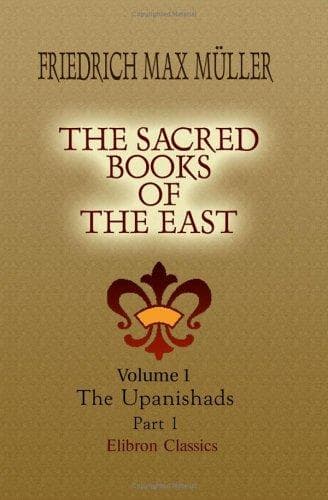
"He, at the time of death, having reached the path of the gods, comes to
the world of Agni, or fire, to the world of Vâyu, or air, to the world
of Varuna, to the world of Indra, to the world of Pragâpati, to the
world of Brahman. In that world there is the lake Âra, the moments
called Yeshtiha, the river Vigarâ, i.e., age-less, the tree Ilyâ, the
city Sâlagya, the palace Aparâgita, i.e., unconquerable, the
door-keepers Indra and Pragâpati, the hall of Brahman, called Vibhu
(built by vibhu, egoism), the throne Vikakshanâ, i.e., perception, the
couch Amitaugas or endless splendor, and the beloved Mânasî, i.e., mind,
and her image Kâkshushî, the eye, who, as if taking flowers, are weaving
the worlds, and the Apsaras, the Ambâs, or sacred scriptures, and
Ambâyavîs, or understanding, and the rivers Ambayâs leading to the
knowledge of Brahman. To this world he who knows the Paryanka-vidyâ
approaches. Brahman says to him: 'Run towards him, servants, with such
worship as is due to myself. He has reached the river Vigarâ, the
age-less, he will never age.'
"Then five hundred Apsaras go towards him, one hundred with garlands in
their hands, one hundred with ointments in their hands, one hundred with
perfumes in their hands, one hundred with garments in their hands, one
hundred with fruit in their hands. They adorn him with an adornment
worthy of Brahman, and when thus adorned with the adornment of Brahman,
the knower of Brahman moves towards Brahman. He comes to the lake Âra,
and he crosses it by the mind, while those who come to it without
knowing the truth, are drowned. He comes to the moments called Yeshtiha,
they flee from him. He comes to the river Vigarâ, and crosses it by the
mind alone, and there shakes off his good and evil deeds. His beloved
relatives obtain the good, his unbeloved relatives the evil he has done.
And as a man, driving in a chariot, might look at the two wheels without
being touched by them, thus he will look at day and night, thus at good
and evil deeds, and at all pairs, all correlative things, such as light
and darkness, heat and cold. Being freed from good and freed from evil,
he, the knower of Brahman, moves towards Brahman.
Public-domain text, read in full here on John Shaqi.
Reviews
Reviews
No reviews yet
Be the first to share your thoughts on this work.
Elsewhere in the archive
Join the Discussion
Join the discussion
Sign in to leave a comment or review.
Sign InorCreate an account