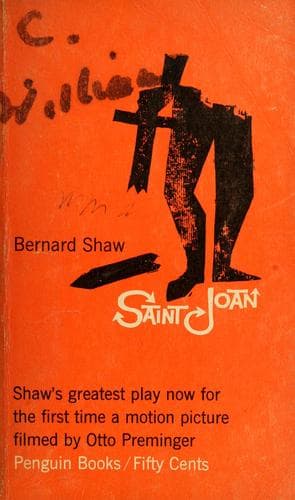
Saint Joan : $b A chronicle play in six scenes and an epilogueShaw, Bernard
HistoryHistory
Saint Joan : $b A chronicle play in six scenes and an epilogue
Shaw, Bernard
Christian women saints -- Drama; France -- History -- Charles VII, 1422-1461 -- Drama; Joan, of Arc, Saint, 1412-1431 -- Drama
CAUCHON. I do not say that there were no supernatural powers on her
side. But the names on that white banner were not the names of Satan and
Beelzebub, but the blessed names of our Lord and His holy mother. And
your commander who was drowned—Clahz-da I think you call him—
WARWICK. Glasdale. Sir William Glasdale.
CAUCHON. Glass-dell, thank you. He was no saint; and many of our people
think that he was drowned for his blasphemies against The Maid.
WARWICK [_beginning to look very dubious_] Well, what are we to infer
from all this, my lord? Has The Maid converted you?
CAUCHON. If she had, my lord, I should have known better than to have
trusted myself here within your grasp.
WARWICK [_blandly deprecating_] Oh! oh! My lord!
CAUCHON. If the devil is making use of this girl—and I believe he is—
WARWICK [_reassured_] Ah! You hear, Messire John? I knew your lordship
would not fail us. Pardon my interruption. Proceed.
CAUCHON. If it be so, the devil has longer views than you give him
credit for.
WARWICK. Indeed? In what way? Listen to this, Messire John.
CAUCHON. If the devil wanted to damn a country girl, do you think so
easy a task would cost him the winning of half a dozen battles? No, my
lord: any trumpery imp could do that much if the girl could be damned at
all. The Prince of Darkness does not condescend to such cheap drudgery.
When he strikes, he strikes at the Catholic Church, whose realm is the
whole spiritual world. When he damns, he damns the souls of the entire
human race. Against that dreadful design The Church stands ever on
guard. And it is as one of the instruments of that design that I see
this girl. She is inspired, but diabolically inspired.
THE CHAPLAIN. I told you she was a witch.
CAUCHON [_fiercely_] She is not a witch. She is a heretic.
THE CHAPLAIN. What difference does that make?
CAUCHON. You, a priest, ask me that! You English are strangely blunt in
the mind. All these things that you call witchcraft are capable of a
natural explanation. The woman’s miracles would not impose on a rabbit:
she does not claim them as miracles herself. What do her victories prove
but that she has a better head on her shoulders than your swearing
Glass-dells and mad bull Talbots, and that the courage of faith, even
though it be a false faith, will always outstay the courage of wrath?
THE CHAPLAIN [_hardly able to believe his ears_] Does your lordship
compare Sir John Talbot, the heir to the earldom of Shrewsbury, to a mad
bull?!!!
WARWICK. It would not be seemly for you to do so, Messire John, as you
are still six removes from a barony. But as I am an earl, and Talbot is
only a knight, I may make bold to accept the comparison. [_To the
Bishop_] My lord: I wipe the slate as far as the witchcraft goes. None
the less, we must burn the woman.
CAUCHON. I cannot burn her. The Church cannot take life. And my first
duty is to seek this girl’s salvation.
WARWICK. No doubt. But you do burn people occasionally.
Public-domain text, read in full here on John Shaqi.
Reviews
Reviews
No reviews yet
Be the first to share your thoughts on this work.
Elsewhere in the archive
Join the Discussion
Join the discussion
Sign in to leave a comment or review.
Sign InorCreate an account