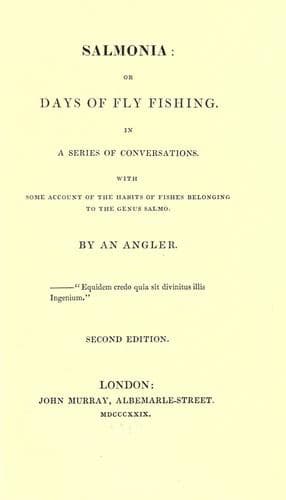
Salmonia; Or, Days of Fly Fishing: In a series of conversations. With some account of the habits of fishes belonging to the genus SalmoDavy, Humphry, Sir
Philosophy
Salmonia; Or, Days of Fly Fishing: In a series of conversations. With some account of the habits of fishes belonging to the genus Salmo
Davy, Humphry, Sir
Fishing
HAL.—You are right, they never have seen any thing like it before; but,
in its motion, it is like a large fly, and this is the season for large
flies. The stone fly and the May fly, you see, occasionally drop upon
the water, and the colour of your large fly is not unlike that of the
stone fly; but if, instead of being here in the beginning of July, you
had visited this spot, as I once did, in the beginning of June, you
would have found more difficulty in catching grayling here, though not
so much as in our English rivers—in the Test, the Derwent, or the Dove.
POIET.—How could this be?
HAL.—At this season the large flies had not yet appeared; the small blue
dun was on the water, and I was obliged to use a fly the same as that
which suits our spring and late autumnal fishing. The fish refused all
large flies, but took greedily small ones; and, as usually happens when
small flies are used, more fish escaped after being hooked than were
taken; and these I found, the next day, were become as sagacious as our
Dove or Test fish, and refused the artificial fly, though they greedily
took the natural fly.
PHYS.—These fish, then, have the same habits as our English salmons and
trouts?
HAL.—The principle to which I have referred in two former conversations
must be general, though it has seemed to me, that they lost this memory
sooner than the fish of our English rivers, where fly fishing is common.
This, however, may be fancy, yet I have referred it to a kind of
hereditary disposition, which has been formed and transmitted from their
progenitors.
PHYS.—However strange it may appear, I can believe this. When the early
voyagers discovered new islands, the birds upon them were quite tame,
and easily killed by sticks and stones, being fearless of man; but they
soon learned to know their enemy, and this newly acquired sagacity was
possessed by their offspring, who had never seen a man. Wild and
domesticated ducks are, in fact, from the same original type: it is only
necessary to compare them, when hatched together under a hen, to be
convinced of the principle of the hereditary transmission of habits,—the
wild young ones instantly fly from man, the tame ones are indifferent to
his presence.
POIET.—No one can be less disposed than I am to limit the powers of
living nature, or to doubt the capabilities of organized structures; but
it does appear to me quite a dream, to suppose that a fish, pricked by
the hook of the artificial fly, should transmit a dread of it to its
offspring, though he does not even long retain the memory of it himself.
HAL.—There are instances quite as extraordinary—but I will not dwell
upon them, as I am not quite sure of the fact which we are discussing; I
have made a guess only, and we must observe more minutely to establish
it; it may be even as you suppose—a mere dream.
Public-domain text, read in full here on John Shaqi.
Reviews
Reviews
No reviews yet
Be the first to share your thoughts on this work.
Elsewhere in the archive
Join the Discussion
Join the discussion
Sign in to leave a comment or review.
Sign InorCreate an account