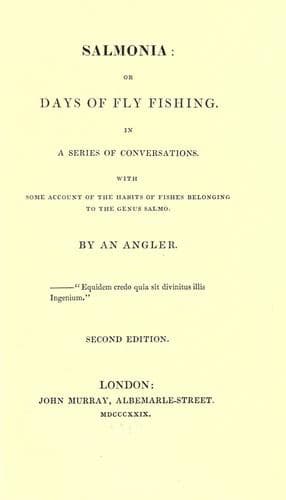
Salmonia; Or, Days of Fly Fishing: In a series of conversations. With some account of the habits of fishes belonging to the genus SalmoDavy, Humphry, Sir
Philosophy
Salmonia; Or, Days of Fly Fishing: In a series of conversations. With some account of the habits of fishes belonging to the genus Salmo
Davy, Humphry, Sir
Fishing
ORN.—Behold! the loss was more owing to the imperfection of the tackle
than to my ardour; for the two end hooks only are gone, and you may see
the gut worn.
HAL.—The thing is done, and is not worth comment. If you can, let the
next fish that rises hook himself. When we are ardent, we are bad judges
of the effort we make; and an angler, who could be cool with a new
species of salmo, I should not envy. Now all is right again: try that
pool. There is a fish—ay! and another, that runs at your bait; but they
are small ones, not much more than twice as large as the bleak; yet they
show their spirit, and though they cannot swallow it, they have torn it.
Put on another bleak. There! you have another run.
ORN.—Ay, it is a small fish, not much more than a foot long; yet he
fights well.
HAL.—You have him, and I will land him. I do not think such a fish a bad
initiation into this kind of sport. He does not agitate so much as a
larger one, and yet gratifies curiosity. There, we have him. A very
beautiful fish; yet he has the leech, or louse, though his belly is
quite white.
ORN.—This fish is so like a trout, that, had I caught him when alone, I
should hardly have remarked his peculiarities; and I am not convinced,
that it is not a variety of the common trout, altered, in many
generations, by the predatory habits of his ancestors.
HAL.—How far the principle of change of character and transmission of
such character to the offspring will apply, I shall not attempt to
determine, and whether all the varieties of the salmo with teeth in
their mouth may not have been produced from one original; yet this fish
is _now_ as distinct from the trout, as the _char_ or the _umbla_ is;
and in Europe, it exists only below great falls in streams connected
with the Danube, and is never found in rivers of the same districts
connected with the Rhine, Elbe, or which empty themselves into the
Mediterranean; though trout are common in all these streams, and salmon
and sea trout in those connected with the ocean. According to the
descriptions of Pallas, it occurs in the rivers of Siberia, and probably
exists in those that run into the Caspian; and it is remarkable, that it
is not found where the eel is usual—at least this applies to all the
tributary streams of the Danube, and, it is said, to the rivers of
Siberia. Wherever I have seen it, there have been always coarse fish—as
chub, white fish, bleak, &c., and rivers containing such fish are its
natural haunts, for it requires abundance of food, and serves to convert
these indifferent poor fish into a better kind of nourishment for man.
We will now examine the interior of these fish. You see the stomach is
larger than that of a trout, and the stomachs of both are full of small
fish. In the larger one there is a chub, a grayling, a bleak, and two or
three small carp. The skin you see is thick; the scales are smaller than
those of a trout; it has no teeth on the palate, and the pectoral fin
Public-domain text, read in full here on John Shaqi.
Reviews
Reviews
No reviews yet
Be the first to share your thoughts on this work.
Elsewhere in the archive
Join the Discussion
Join the discussion
Sign in to leave a comment or review.
Sign InorCreate an account