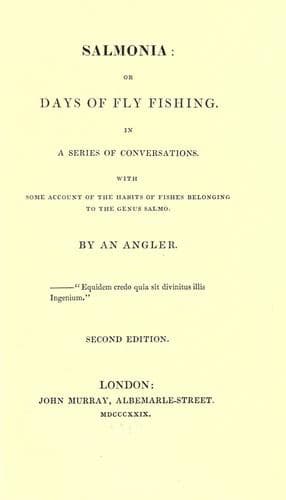
Salmonia; Or, Days of Fly Fishing: In a series of conversations. With some account of the habits of fishes belonging to the genus SalmoDavy, Humphry, Sir
Philosophy
Salmonia; Or, Days of Fly Fishing: In a series of conversations. With some account of the habits of fishes belonging to the genus Salmo
Davy, Humphry, Sir
Fishing
HAL.—You may do so; but many of these fish cannot be caught; they
migrate generally when the water is foul, and, except in the spring and
autumn, do not so readily run at the bait. I was once nearly a month
seeking for one in rivers in which they are found, between the end of
June and that of July, without being able to succeed in even _seeing_
one alive; and as far as my information goes, the two places where there
is most probability of taking them, are at Laybach and Ratisbon, in the
tributary streams to the Sava, and in the Danube; and the best time, in
the first of these situations, is in March and April, and in the second,
in May. I am told, likewise, that the Izar, which runs by Munich, is a
stream where they may be caught, when the water is clear: but I have
never fished in this stream—it having been foul, either from rain, or
the melting of the snows, whenever I have been at Munich; but I have
seen in the fish-market at Munich very large huchos. Late in the autumn,
or in early spring, this river must be an interesting one to fish in, as
the _schill_, or _perca lucio perca_, and three other species of _perca_
are found in it—the zingel, the apron, and the _perca_ schratz—all fish
of prey, and excellent food. I have eaten them, but never taken them;
they are rare in European rivers, though not, like the hucho, peculiar
to the tributary streams of the Danube. The schill is found likewise in
the Sprey and in the Hungarian lakes, and, according to Bloch, the
zingel in the Rhone.
POIET.—I should like extremely to fish in the Izar: it is, I think, a
new kind of pleasure to take a new kind of fish, even though it is not
unknown to Natural Historians. But the most exquisite kind of angling,
in my opinion, would be that of angling in a river never fished in by
Europeans before; and I can scarcely imagine sport of a higher kind than
that which involves a triple source of pleasure—catching a fish,
procuring good food for the table, and making a discovery in Natural
History, at the same time. Sir Joseph Banks, who was always a great
amateur of angling, had often this kind of gratification. And to Captain
Franklin and Dr. Richardson, in their expedition to the Arctic Ocean,
when they were almost starving, what a delightful circumstance it must
have been, to have taken with a fly those large grayling, which they
mention, of a new species, equally beautiful in their appearance, and
good for the table!
HAL.—When a boy, I have felt an interest in sea fishing, for this
reason—that there was a variety of fish; but the want of skill in the
amusement—sinking a bait with a lead and pulling up a fish by main
force, soon made me tired of it. Since I have been a fly-fisher, I have
rarely fished in the sea, and then only with a reel and fine tackle from
the rocks, which is at least as interesting an amusement as that of the
Cockney fishermen, who fish for roach and dace in the Thames, which I
have tried twice in my life, but shall never try again.
Public-domain text, read in full here on John Shaqi.
Reviews
Reviews
No reviews yet
Be the first to share your thoughts on this work.
Elsewhere in the archive
Join the Discussion
Join the discussion
Sign in to leave a comment or review.
Sign InorCreate an account