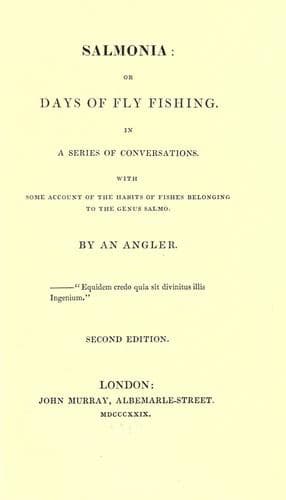
Salmonia; Or, Days of Fly Fishing: In a series of conversations. With some account of the habits of fishes belonging to the genus SalmoDavy, Humphry, Sir
Philosophy
Salmonia; Or, Days of Fly Fishing: In a series of conversations. With some account of the habits of fishes belonging to the genus Salmo
Davy, Humphry, Sir
Fishing
HAL.—I disbelieve the authenticity of these stories. I do not mean to
deny the existence of large marine animals having analogies to the
serpent; the conger we know is such an animal: I have seen one nearly
ten feet long, and there may be longer ones, but such animals do not
come to the surface. The only sea snake, that has been examined by
naturalists, turned out to be a putrid species of shark—the _squalus
maximus_. Yet all the newspapers gave accounts of this as a real animal,
and endowed it with feet, which do not belong to serpents. And the sea
snakes, seen by American and Norwegian captains, have, I think,
generally been a company of porpoises, the rising and sinking of which
in lines would give somewhat the appearance of the coils of a snake. The
kraken, or island fish, is still more imaginary. I have myself seen
immense numbers of enormous _urticæ marinæ_, or blubbers, in the north
seas, and in some of the Norwegian _fiords_, or inland bays, and often
these beautiful creatures give colour to the water; but it is
exceedingly improbable, that an animal of this genus should ever be of
the size, even of the whale; its soft materials are little fitted for
locomotion, and would be easily destroyed by every kind of fish. Hands
and a finny tail are entirely contrary to the analogy of nature, and I
disbelieve the mermaid upon philosophical principles. The dugong and
manatee are the only animals combining the functions of the mammalia
with some of the characters of fishes, that can be imagined, even as a
link, this part of the order of nature. Many of these stories have been
founded upon the long-haired seal seen at a distance, others on the
appearance of the common seal under particular circumstances of light
and shade, and some on still more singular circumstances. A worthy
baronet, remarkable for his benevolent views and active spirit, has
propagated a story of this kind, and he seems to claim for his native
country the honour of possessing this extraordinary animal; but the
mermaid of Caithness was certainly a _gentleman_, who happened to be
travelling on that wild shore, and who was seen bathing by some young
ladies at so great a distance, that not only _genus_ but gender was
mistaken. I am acquainted with him, and have had the story from his own
mouth. He is a young man, fond of geological pursuits, and one day in
the middle of August, having fatigued and heated himself by climbing a
rock to examine a particular appearance of a granite, he gave his
clothes to his Highland guide, who was taking care of his pony, and
descended to the sea. The sun was just setting, and he amused himself
for some time by swimming from rock to rock, and having unclipped hair
and no cap, he sometimes threw aside his locks, and wrung the water from
them on the rocks. He happened the year after to be at Harrowgate, and
was sitting at table with two young ladies from Caithness, who were
relating to a wondering audience the story of the mermaid they had seen,
Public-domain text, read in full here on John Shaqi.
Reviews
Reviews
No reviews yet
Be the first to share your thoughts on this work.
Elsewhere in the archive
Join the Discussion
Join the discussion
Sign in to leave a comment or review.
Sign InorCreate an account