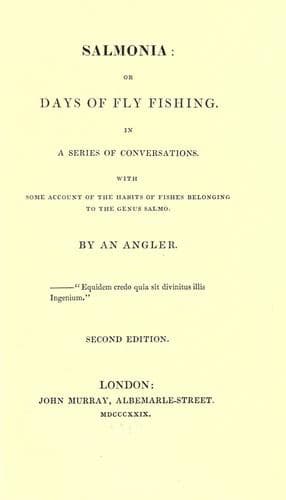
Salmonia; Or, Days of Fly Fishing: In a series of conversations. With some account of the habits of fishes belonging to the genus Salmo — John Shaqi
Salmonia; Or, Days of Fly Fishing: In a series of conversations. With some account of the habits of fishes belonging to the genus SalmoDavy, Humphry, Sir
Philosophy
Salmonia; Or, Days of Fly Fishing: In a series of conversations. With some account of the habits of fishes belonging to the genus Salmo
Davy, Humphry, Sir
Fishing
PHYS.—I am sorry we did not examine more minutely the weight and size of
the fish we caught, and compare the anatomy of the salmon and the sea
trout; but we were in too great a hurry to see them on the table, and
our philosophy yielded to our hunger.
HAL.—We shall have plenty of opportunities for this examination; and we
can now walk down to the fishing-house and see probably half a hundred
fish of different sizes, that have been taken in the cruives, this
evening, and examine them at our leisure.
ALL.—Let us go!
PHYS.—I never saw so many fish of this kind before; and I conclude that
heap of smaller fish is composed of trout.
HAL.—Certainly. Let us compare one of the largest trout with a salmon. I
have selected two fresh run fish, which, from their curved lower jaws,
are, I conclude, both males. The salmon you see is broader, has a tail
rather more forked, and the teeth in proportion are rather smaller. The
trout, likewise, has larger and more black brown spots on the body; and
the head of the trout is a little larger in proportion. The salmon has
14 spines in the pectoral fins, 10 in each of the ventral, 13 in the
anal, 21 in the caudal, and 15 in the dorsal. The salmon measures 38½
inches in length and 21 inches in girth, and his weight, as you see, is
22¼lbs. The trout has one spine less in the pectoral, and two less in
the anal fin, and measures 30¼ inches in length, and 16 inches in girth,
and his weight is 11lbs. We will now open them. The stomach of the
salmon, you perceive, contains nothing but a little yellow fluid, and,
though the salmon is twice as large, does not exceed much in size that
of the trout. The stomach of the trout, unlike that of the salmon, will
be found full of food: we will open it. See, there are half digested
sand eels which come out of it.
PHYS.—But surely the stomachs of salmon must sometimes, when opened,
contain food?
HAL.—I have opened ten or twelve, and never found any thing in their
stomachs but tape-worms, bred there, and some yellow fluid; but, I
believe, this is generally owing to their being caught at the time of
migration, when they are travelling from the sea upwards, and do not
willingly load themselves with food. Their digestion appears to be very
quick, and their habits seem to show, that after having taken a bait in
the river they do not usually seek another, till the work of digestion
is nearly performed: but when they are taken at sea, and in rivers in
the winter, food, I am told, is sometimes found in their stomachs. The
sea trout is a much more voracious fish, and, like the land trout, is
not willingly found with an empty stomach.
PHYS.—I presume the sea trout is the fish called by Linnæus, in his
Fauna, _Salmo Eriox_?
HAL.—I know not: but I should rather think that fish a variety of the
common salmon.
Public-domain text, read in full here on John Shaqi.
Reviews
Reviews
No reviews yet
Be the first to share your thoughts on this work.
Join the Discussion
Join the discussion
Sign in to leave a comment or review.
Sign InorCreate an account