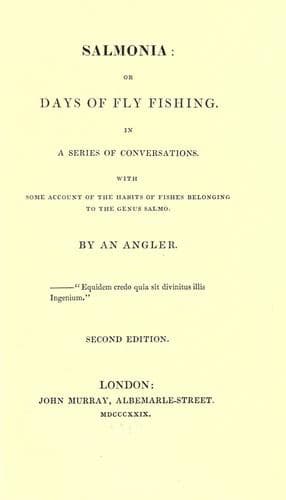
Salmonia; Or, Days of Fly Fishing: In a series of conversations. With some account of the habits of fishes belonging to the genus SalmoDavy, Humphry, Sir
Philosophy
Salmonia; Or, Days of Fly Fishing: In a series of conversations. With some account of the habits of fishes belonging to the genus Salmo
Davy, Humphry, Sir
Fishing
PHYS.—I envy no quality of the mind or intellect in others; be it
genius, power, wit, or fancy: but if I could choose what would be most
delightful, and I believe most useful to me, I should prefer a firm
religious belief to every other blessing; for it makes life a discipline
of goodness; creates new hopes, when all earthly hopes vanish; and
throws over the decay, the destruction of existence, the most gorgeous
of all lights; awakens life even in death, and from corruption and decay
calls up beauty and divinity; makes an instrument of torture and of
shame the ladder of ascent to paradise: and, far above all combinations
of earthly hopes, calls up the most delightful visions of palms and
amaranths, the gardens of the blest, the security of everlasting joys,
where the sensualist and the sceptic view only gloom, decay,
annihilation, and despair!
POIET.—You transiently referred, Halieus, yesterday, to that instinct of
salmons which induces them to run up rivers from the sea on the approach
of rain. You have had so many opportunities of attending to the
instincts of the inferior animals, that I should be very glad to hear
your opinion on that very curious subject, the nature and developement
of instincts in general.
HAL.—You must remember, that, in the conversation to which you allude, I
avoided even to pretend to define the nature of instinct; but I shall
willingly discuss the subject; and I expect from yourself, Ornither and
Physicus, more light thrown upon it than I can hope to bestow.
ORN.—I believe we have each a peculiar view on this matter. In
discussion we may enlighten and correct each other. For myself, I
consider instincts merely as results of organization, a part of the
machinery of organized forms. Man is so constituted, that his muscles
acquire their power by habit; their motions are at first automatic, and
become voluntary by associations, so that a child must learn to walk as
he learns to swim or write; but in the colt or chicken, the limbs are
formed with the powers of motion; and these animals walk as soon as they
have quitted the womb or the egg.
PHYS.—I believe it possible, that they may have acquired these powers of
motion in the embryo state; and I think I have observed, that birds
learn to fly, and acquire the use of their wings, by continued efforts,
in the same manner as a child does that of his limbs.
Public-domain text, read in full here on John Shaqi.
Reviews
Reviews
No reviews yet
Be the first to share your thoughts on this work.
Elsewhere in the archive
Join the Discussion
Join the discussion
Sign in to leave a comment or review.
Sign InorCreate an account