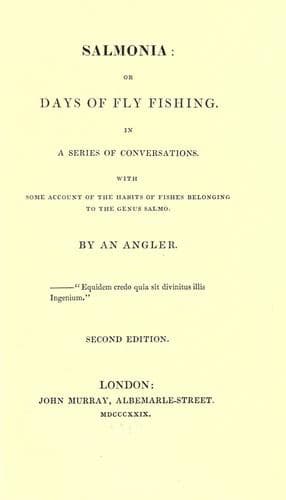
Salmonia; Or, Days of Fly Fishing: In a series of conversations. With some account of the habits of fishes belonging to the genus SalmoDavy, Humphry, Sir
Philosophy
Salmonia; Or, Days of Fly Fishing: In a series of conversations. With some account of the habits of fishes belonging to the genus Salmo
Davy, Humphry, Sir
Fishing
ORN.—I cannot agree with you: the legs of the fœtus are folded up in the
womb of the mare; and neither the colt nor the chicken can ever have
performed, in the embryo state, any motions of their legs similar to
those which they have perfectly at their command when born. Young birds
cannot fly as soon as they are hatched, because they have no wing
feathers; but as soon as these are developed, and even before they are
perfectly strong, they use their wings, fly, and quit their nests
without any education from their parents. Compare a young quail, when a
few days old, with a child of as many months: he flies, runs, seeks his
food, avoids danger, and obeys the call of his mother; whilst a child is
perfectly helpless, and can perform few voluntary motions: has barely
learnt to grasp, and can neither stand nor walk. But to see the most
perfect instance of instinct, as contrasted with acquired knowledge,
look at common domestic poultry, as soon as they are excluded from the
egg: they run round their mother, nestle in her feathers, and obey her
call, without education: she leads them to some spot where there is soft
earth or dung, and instantly begins scratching with her feet; the
chickens watch her motions with the utmost attention; if an earthworm or
larva is turned up, they instantly seize and devour it, but they avoid
eating sticks, grass, or straws; and though the hen shows them the
example of picking up grain, they do not imitate her in this respect,
but for some days prefer ants, or the larvæ of ants, to a barley corn.
They may have heard the cluck of their mother in the egg, and having
felt the warmth of her feathers agreeable, you may consider, Physicus,
their collecting under her wings, and obeying her call, as an acquired
habit. But I will mention another circumstance where habit or education
is entirely out of the question. Does the mother see the shadow of a
kite on the ground, or hear his scream in the air, she instantly utters
a shrill suppressed cry; the chickens, though born that day, and
searching round her with glee and animation for the food which her feet
were providing for them, instantly appear as if thunder struck; those
close to her crouch down and hide themselves in the straw; those further
off, without moving from the place, remain prostrate; the hen looks
upward with a watchful eye; nor do they resume their feeding till they
have been called again by the cluck of their mother, and warned that the
danger is over.
PHYS.—I certainly cannot explain the acquaintance of the little animals
with the note of alarm of the mother, except upon the principle you have
adopted; and I fairly own, that their selection of animal food appears
likewise instinctive: yet it is possible, that this selection may depend
upon some analogy between the smell of these animal matters and the
yolk, which was for a long time their food in the egg.
Public-domain text, read in full here on John Shaqi.
Reviews
Reviews
No reviews yet
Be the first to share your thoughts on this work.
Elsewhere in the archive
Join the Discussion
Join the discussion
Sign in to leave a comment or review.
Sign InorCreate an account